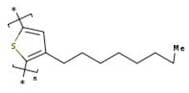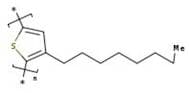
CAS 104934-51-2
:Poly(3-octylthiophene)
Description:
Poly(3-octylthiophene), commonly abbreviated as P3OT, is a conjugated polymer known for its semiconducting properties, making it valuable in organic electronics, particularly in organic solar cells and field-effect transistors. This polymer is derived from the polymerization of 3-octylthiophene monomers, which introduces long alkyl side chains that enhance solubility in organic solvents and improve film-forming capabilities. P3OT exhibits a high degree of π-conjugation, leading to significant electrical conductivity and optical properties, including strong absorption in the visible region. Its structural characteristics include a backbone of thiophene rings, which contribute to its stability and electronic properties. The presence of the octyl side chains not only aids in solubility but also influences the polymer's morphology and crystallinity, which are critical for its performance in electronic applications. Additionally, P3OT can be processed using various techniques, such as spin-coating and inkjet printing, making it suitable for flexible and lightweight electronic devices. Overall, P3OT is a prominent material in the field of organic electronics due to its favorable properties and versatility.
Formula:(C12H20S)x
InChI:InChI=1S/C12H20S/c1-2-3-4-5-6-7-8-12-9-10-13-11-12/h9-11H,2-8H2,1H3
InChI key:InChIKey=WQYWXQCOYRZFAV-UHFFFAOYSA-N
SMILES:C(CCCCCCC)C=1C=CSC1
Synonyms:- 3-Octylthiophene homopolymer
- Poly(3-n-octylthiophene)
- Poly(3-octyl-2,5-thiophene)
- Poly(3-octylthiophene)
- Poly(3-octylthiophene-2,5-diyl), regiorandom
- Thiophene, 3-octyl-, homopolymer
Sort by
Purity (%)
0
100
|
0
|
50
|
90
|
95
|
100
Found 4 products.
Poly(3-octylthiophene-2,5-diyl), regiorandom, low metals
CAS:Conducting polymersFormula:(C12H18S)nColor and Shape:Green to brownPoly(3-octylthiophene-2,5-diyl), regioregular, low metals
CAS:Conducting polymersFormula:(C12H18S)nColor and Shape:Fibers, Green to brownPoly(3-octylthiophene-2,5-diyl)
CAS:Poly(3-octylthiophene-2,5-diyl) is a polymer that can be synthesized by a synthetic scheme. It has optical properties and redox potentials that are dependent on the concentration of the polymer. The presence of biphenyl in the polymer film affects its electronic interaction and detection time. FT-IR spectroscopy and electrochemical impedance spectroscopy have been used to study the structural analysis of this polymer and its morphology. Coatings containing this polymer have been shown to be effective in reducing corrosion rates on steel and aluminum substrates.
Formula:C12H18SPurity:Min. 95%Molecular weight:194.11292