CAS 107220-28-0
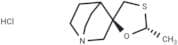
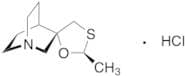
:Cevimeline hydrochloride
- Af 102B
- Cevimeline hydrochloride
- Evoxac
- Fks 508
- Saligren
- Snd 5008
- Sni 2011
- Snk 508
- Spiro(1-azabicyclo(2.2.2)octane-3,5'-(1,3)oxathiolane), 2'-methyl-, hydrochloride, cis-
- Spiro(1-azabicyclo(2.2.2)octane-3,5'-(1,3)oxathiolane), 2'-methyl-, hydrochloride, trans-
- Spiro[1-azabicyclo[2.2.2]octane-3,5′-[1,3]oxathiolane], 2′-methyl-, hydrochloride (1:1), (2′R,3R)-rel-
- Spiro[1-azabicyclo[2.2.2]octane-3,5′-[1,3]oxathiolane], 2′-methyl-, hydrochloride, (2′R,3R)-rel-
- cis-(+-)-2'-Methylspiro(1-azabicyclo(2.2.2)octane-3,5'-(1,3)oxathiolane) hydrochloride
- cis-2-Methylspiro[1,3-oxathiolane-5,3′-quinuclidine] hydrochloride
- See more synonyms
Cevimeline Hydrochloride Salt
CAS:Formula:C10H18ClNOSPurity:91%Color and Shape:SolidMolecular weight:235.7740rel-(2R,3'R)-2-Methyl-1'-azaspiro[[1,3]oxathiolane-5,3'-bicyclo[2.2.2]octane] hydrochloride
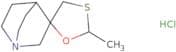
CAS:rel-(2R,3'R)-2-Methyl-1'-azaspiro[[1,3]oxathiolane-5,3'-bicyclo[2.2.2]octane] hydrochloridePurity:98%Molecular weight:235.78g/molCevimeline hydrochloride
CAS:Cevimeline HCl is a muscarinic agonist enhancing salivary and sweat gland secretion.Formula:C10H18ClOSColor and Shape:SolidMolecular weight:235.77Cevimeline Hydrochloride Salt
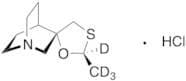
CAS:Controlled ProductFormula:C10H17NOS·ClHColor and Shape:NeatMolecular weight:235.77Cevimeline-d4 Hydrochloride Salt (Major)
CAS:Controlled ProductApplications A labelled muscarinic M1 and M3 receptor agonist. Sialagogue.
Not a dangerous good if item is equal to or less than 1g/ml and there is less than 100g/ml in the package
References Masunaga, H., et al.: Eur. J. Pharmacol., 339, 1 (1997), Arisawa, H., et al.: Arzneim.-Forsch., 52, 14 (2002), Yasuda, H., et al.: Clin. Drug Invest., 22, 67 (2002), Ono, M., et al.: Am. J. Ophthalmol., 138, 6 (2004),Formula:C10H14D4ClNOSColor and Shape:NeatMolecular weight:239.8Cevimeline hydrochloride
CAS:Cevimeline hydrochloride salt is a cholinergic drug that activates the muscarinic receptors in the salivary glands. It has been used for the treatment of dry mouth and xerostomia in patients with Sjögren's syndrome, diabetes, or following radiation therapy. Cevimeline hydrochloride has been shown to increase the production of saliva in animal models of Sjögren's syndrome by stimulating cAMP-dependent protein kinase A (PKA) activity. This drug also has anti-inflammatory properties, which may be due to its inhibition of prostaglandin synthesis. Cevimeline hydrochloride salt can cause side effects such as eye disorders, skin cancer, and geriatric patients with adenosine A3 receptor antagonists. Benzalkonium chloride is an ingredient in cevimeline hydrochloride salt that acts as a preservative and antimicrobial agent.
Formula:C10H17NOS•HClPurity:Min. 95%Color and Shape:PowderMolecular weight:235.77 g/molRef: 3D-FC19916
Discontinued product
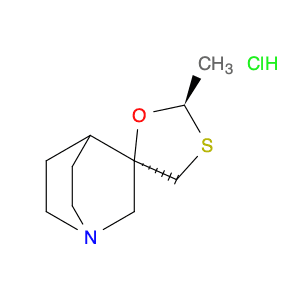

![rel-(2R,3'R)-2-Methyl-1'-azaspiro[[1,3]oxathiolane-5,3'-bicyclo[2.2.2]octane] hydrochloride](/_next/image/?url=https%3A%2Fstatic.cymitquimica.com%2Fproducts%2F54%2Fthumb%2FOR1073972.jpg&w=3840&q=75)