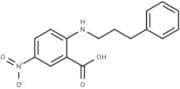
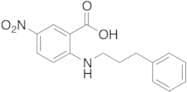
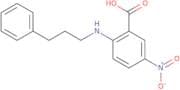
![5-Nitro-2-[(3-phenylpropyl)amino]benzoic acid](/_next/image/?url=https%3A%2Fstatic.cymitquimica.com%2Fcas-image%2Fthumb-webp%2F273228-5-nitro-2-3-phenylpropyl-amino-benzoic-acid.webp&w=3840&q=75)
CAS 107254-86-4
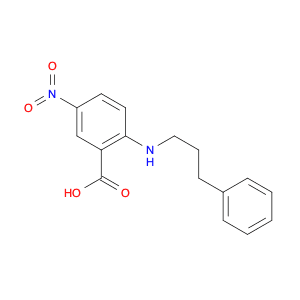
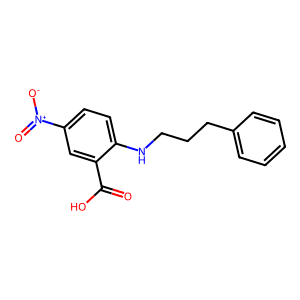
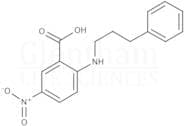
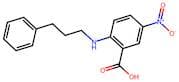
:5-Nitro-2-[(3-phenylpropyl)amino]benzoic acid
Description:
5-Nitro-2-[(3-phenylpropyl)amino]benzoic acid is an organic compound characterized by its aromatic structure, which includes a nitro group and an amino group attached to a benzoic acid framework. The presence of the nitro group typically imparts electrophilic properties, while the amino group can act as a nucleophile, influencing the compound's reactivity and potential interactions in biological systems. The 3-phenylpropyl substituent enhances the compound's hydrophobic characteristics, which may affect its solubility and permeability in biological membranes. This compound may exhibit various biological activities, making it of interest in medicinal chemistry and pharmacology. Its molecular structure suggests potential applications in drug development, particularly in targeting specific biological pathways. Additionally, the compound's properties, such as melting point, solubility, and stability, would be influenced by the functional groups present and their interactions. As with many organic compounds, safety and handling precautions should be observed due to potential toxicity associated with nitro and amino groups.
Formula:C16H16N2O4
InChI:InChI=1S/C16H16N2O4/c19-16(20)14-11-13(18(21)22)8-9-15(14)17-10-4-7-12-5-2-1-3-6-12/h1-3,5-6,8-9,11,17H,4,7,10H2,(H,19,20)
InChI key:InChIKey=WBSMIPAMAXNXFS-UHFFFAOYSA-N
SMILES:N(CCCC1=CC=CC=C1)C2=C(C(O)=O)C=C(N(=O)=O)C=C2
Synonyms:- 5-Nitro-2-[(3-Phenylpropyl)Amino]Benzoic Acid
- Benzoic acid, 5-nitro-2-[(3-phenylpropyl)amino]-
- Hoe 144
- Hoechst 144
- Nppb
Sort by
Purity (%)
0
100
|
0
|
50
|
90
|
95
|
100
Found 8 products.
5-Nitro-2-(3-phenylpropylamino)benzoic acid
CAS:Formula:C16H16N2O4Purity:99%Color and Shape:SolidMolecular weight:300.3092NPPB
CAS:NPPB is a chloride channel blocker with IC50 of 80 nM .Formula:C16H16N2O4Purity:99.95%Color and Shape:Light Yellow To Yellow SolidMolecular weight:300.31NPPB
CAS:NPPB is a polymeric cation channel that is activated by cytosolic Ca2+ and regulates the membrane potential of cells. It has been shown to be involved in the regulation of energy metabolism, chloride transport, and cancer cell growth. NPPB also plays an important role in neuronal death, as it can activate pro-apoptotic protein channels and regulate the release of intracellular calcium. NPPB is found predominantly in the apical region of mitochondria membranes, but can also be found in other locations such as the plasma membrane. It is regulated by oxidative injury and changes in mitochondrial membrane potential.Formula:C16H16N2O4Purity:Min. 95%Molecular weight:300.31 g/mol