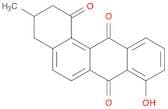
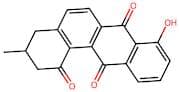
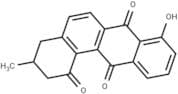
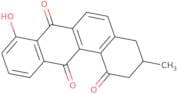
CAS 111540-00-2
:STA-21
Description:
STA-21, with the CAS number 111540-00-2, is a chemical compound that has garnered attention in the field of medicinal chemistry, particularly for its potential therapeutic applications. It is classified as a small molecule and is known to act as a selective inhibitor of certain protein interactions, specifically targeting the heat shock protein 90 (Hsp90) pathway. This inhibition can disrupt the function of various client proteins involved in cancer cell proliferation and survival, making STA-21 a candidate for cancer treatment research. The compound exhibits a specific binding affinity, which is crucial for its effectiveness in modulating biological pathways. Additionally, STA-21 has been studied for its pharmacokinetic properties, including absorption, distribution, metabolism, and excretion (ADME), which are essential for evaluating its potential as a drug. Its chemical structure and properties contribute to its biological activity, and ongoing research aims to further elucidate its mechanisms and optimize its therapeutic efficacy.
Formula:C19H14O4
Synonyms:- 8-HYDROXY-3-METHYL-1,2,3,4,7,12-HEXAHYDROTETRAPHENE-1,7,12-TRIONE
- Ochromycinone (STA-21)
- STA 21
- (Rac)-STA-21
- STA-21 >=95% (HPLC)
Sort by
Purity (%)
0
100
|
0
|
50
|
90
|
95
|
100
Found 5 products.
Ochromycinone
CAS:Ochromycinone (STA 21) is a selective STAT3 inhibitor.Formula:C19H14O4Purity:99.21%Color and Shape:SolidMolecular weight:306.31Ref: TM-T6995
1mg92.00€5mg130.00€10mg215.00€25mg444.00€50mg782.00€100mg1,054.00€1mL*10mM (DMSO)142.00€Ochromycinone (STA-21)
CAS:Ochromycinone is a neurotrophic factor that has been shown to inhibit the growth of skin cancer cells. It has been shown to induce the production of neurotrophic factors, which are proteins that promote neuronal survival and growth. Ochromycinone also has biological properties that have been associated with cellular transformation and tumorigenesis. This protein binds to dinucleotide phosphate (DNP) and inhibits polymerase chain reaction (PCR) by binding to DNA in vitro. Ochromycinone may be a potential drug target for infectious diseases such as HIV or herpes simplex virus infections. It has also been shown to inhibit Toll-like receptor (TLR) signaling pathways in experimental models.Formula:C19H14O4Purity:Min. 95%Molecular weight:306.31 g/mol