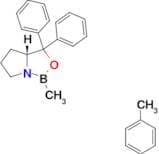
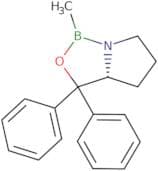
CAS 112022-83-0
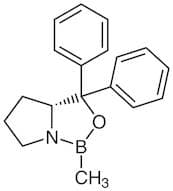
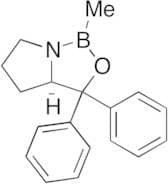
:(R)-2-Methyl-CBS-oxazaborolidine
Formula:C18H20BNO
InChI:InChI=1S/C18H20BNO/c1-19-20-14-8-13-17(20)18(21-19,15-9-4-2-5-10-15)16-11-6-3-7-12-16/h2-7,9-12,17H,8,13-14H2,1H3/t17-/m1/s1
InChI key:InChIKey=VMKAFJQFKBASMU-QGZVFWFLSA-N
SMILES:CB1OC([C@@]2(N1CCC2)[H])(C3=CC=CC=C3)C4=CC=CC=C4
Synonyms:- (3AR)-1-methyl-3,3-diphenyl-3a,4,5,6-tetrahydropyrrolo[1,2-c][1,3,2]oxazaborole
- (3aR)-1-methyl-3,3-diphenyltetrahydro-3H-pyrrolo[1,2-c][1,3,2]oxazaborole
- (3aR)-Tetrahydro-1-methyl-3,3-diphenyl-1H,3H-pyrrolo[1,2-c][1,3,2]oxazaborole
- (R)-(+)-2-Methyl-CBS-oxazaborolindine
- (R)-1-Methyl,3,3-Diphenyl-TETRAHYDRO-PYRROLO(1,2-C)(1,3,2)oxazaborole
- (R)-1-Methyl-3,3-diphenylhexahydropyrrolo[1,2-c]-[1,3,2]oxazaborole
- (R)-3,3-Diphenyl-1-MethylTETRAHYDRO-1H,3H-PYRROLO[1,2-C][1,3,2]oxazaborole
- (R)-3,3-Diphenyl-1-MethylTETRAHYDRO-3H-PYRROLO-[1,2-C][1,3,2]oxazaborole
- (R)-3,3-Diphenyl-1-methylpyrrolidino[1,2-c]-1,3,2-oxazaborole
- (R)-5,5-Diphenyl-2-Methyl-3,4-PROPANO-1,3,2-oxazaborolidine
- (R)-Me-CBS
- (R)-Me-Corey-Bakshi-Shibata reagent
- (R)-Methyl oxazaborolidine
- (R)-Methyl-CBS
- (R)-Tetrahydro-1-methyl-3,3-diphenyl-1H,3H-pyrrolo[1,2-c][1,3,2]oxazaborole
- (R-Methyl-Corey-Bakshi-Shibata catalyst
- 1H,3H-Pyrrolo[1,2-c][1,3,2]oxazaborole, tetrahydro-1-methyl-3,3-diphenyl-, (3aR)-
- 1H,3H-Pyrrolo[1,2-c][1,3,2]oxazaborole, tetrahydro-1-methyl-3,3-diphenyl-, (R)-
- ALPHA,ALPHA-Diphenyl-D-PROLINOL METHYLBORONIC ACID CYCL-AMIDE-ESTER
- See more synonyms
Sort by
Purity (%)
0
100
|
0
|
50
|
90
|
95
|
100
Found 10 products.
(R)-5,5-Diphenyl-2-methyl-3,4-propano-1,3,2-oxazaborolidine (ca. 1mol/L in Toluene)
CAS:Formula:C18H20BNOColor and Shape:Colorless to Light yellow clear liquidMolecular weight:277.17(R)-2-Methyl-CBS-oxazaborolidine, 1M soln. in toluene
CAS:(R)-2-Methyl-CBS-oxazaborolidine is used in the asymmetric reduction of prochiral ketones. Other applications include the enantioselective synthesis of -hydroxy acids, -amino acids, C2 symmetrical ferrocenyl diols, and propargyl alcohols. It is also used in a desymmetrizing reduction leading to (S)-Formula:C18H20BNOColor and Shape:Clear colorless to yellow to orange, LiquidMolecular weight:277.17CALLERY™ (R)-Methyl oxazaborolidine, 1M in toluene
CAS:(R)-Tetrahydro-1-methyl-3,3-diphenyl-1H,3H-pyrrolo[1,2-c][1,3,2]oxazaborole, 0.9-1.1M in toluene [(R)-Methyloxazaborolidine] (R)-CBS Catalyst
Formula:C18H20BNOColor and Shape:colorless to amber liq.Molecular weight:277.17(R)-1-methyl-3,3-diphenylhexahydropyrrolo[1,2-c][1,3,2]oxazaborole
CAS:Formula:C18H20BNOPurity:98%Color and Shape:SolidMolecular weight:277.1685Ref: IN-DA00327K
1kgTo inquire1g20.00€5g32.00€10g46.00€25g61.00€50g106.00€100g151.00€250g258.00€500g612.00€(R)-Tetrahydro-1-methyl-3,3-diphenyl-1H,3H-pyrrolo[1,2-c][1,3,2]oxazaborole
CAS:(R)-Tetrahydro-1-methyl-3,3-diphenyl-1H,3H-pyrrolo[1,2-c][1,3,2]oxazaboroleFormula:C18H20BNOPurity:97%,99.5%eeColor and Shape: brown liquidMolecular weight:277.17g/mol(R)-5,5-Diphenyl-2-methyl-3,4-propano-1,3,2-oxazaborolidine
CAS:Formula:C18H20BNOPurity:>97.0%(T)Color and Shape:White to Almost white powder to crystalMolecular weight:277.17(R)-(+)-2-Methyl-CBS-oxazaborolidine (1 M in Toluene)
CAS:Controlled ProductFormula:C18H20BNOColor and Shape:Single SolutionMolecular weight:277.17(R)-1-methyl-3,3-diphenylhexahydropyrrolo[1,2-c][1,3,2]oxazaborole
CAS:Purity:98%, ee99%Molecular weight:277.1700134(R)-Methyl oxazaborolidine 1M in toluene
CAS:Formula:C25H28BNOPurity:95.0%Color and Shape:Liquid, ClearMolecular weight:369.32(R)-(+)-2-Methyl-CBS-oxazaborolidine
CAS:(R)-(+)-2-Methyl-CBS-oxazaborolidine is a dpp-iv inhibitor that is a β-unsaturated ketone. It has been shown to inhibit the enzyme histone lysine demethylase, which may be involved in the regulation of bone mass. This compound also has a pharmacokinetic profile that is characterized by high oral bioavailability, low plasma protein binding, and rapid metabolism by liver enzymes. The reaction mechanism for this compound is based on the formation of an enolate carbanion. (R)-(+)-2-Methyl-CBS-oxazaborolidine can be synthesized with high stereoselectivity and yields from reactions with simple starting materials. This synthetic route also has a number of advantages over other methods: it does not require any protecting groups, it does not use toxic solvents such as dichloromethane or chloroform, and it can be performed in anhydrous conditionsFormula:C18H20BNOPurity:Min. 95%Color and Shape:SolidMolecular weight:277.17 g/mol


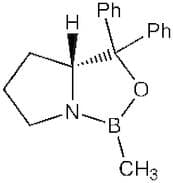

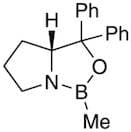

![(R)-1-methyl-3,3-diphenylhexahydropyrrolo[1,2-c][1,3,2]oxazaborole](/_next/image/?url=https%3A%2Fstatic.cymitquimica.com%2Fproducts%2FIN%2Fthumb%2FDA00327K.jpg&w=3840&q=75)

![(R)-Tetrahydro-1-methyl-3,3-diphenyl-1H,3H-pyrrolo[1,2-c][1,3,2]oxazaborole](/_next/image/?url=https%3A%2Fstatic.cymitquimica.com%2Fproducts%2F54%2Fthumb%2FOR360007.jpg&w=3840&q=75)


![(R)-1-methyl-3,3-diphenylhexahydropyrrolo[1,2-c][1,3,2]oxazaborole](/_next/image/?url=https%3A%2Fstatic.cymitquimica.com%2Fproducts%2F10%2Fthumb%2FF862335.jpg&w=3840&q=75)