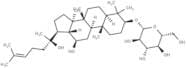
![(2R,3R,4S,5R,6R)-2-[[(10S,12S,14R,17S)-12-hydroxy-17-[(2R)-2-hydroxy-6 -methyl-hept-5-en-2-yl]-4,4…](/_next/image/?url=https%3A%2Fstatic.cymitquimica.com%2Fcas-image%2Fthumb-webp%2F166941-2r-3r-4s-5r-6r-2-10s-12s-14r-17s-12-hydroxy-17-2r-2-hydroxy-6-methyl-hept-5-en-2-yl-44101417-pentamethyl-235678911121-31516-dodecahydro-1h-cyclopenta-a-phenanthren-3-yl-oxy-6-hydroxyme-thyl-oxane-345-triol.webp&w=3840&q=75)
CAS 112246-15-8
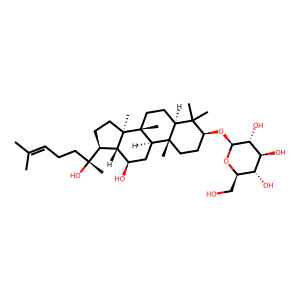
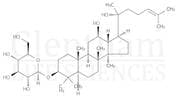
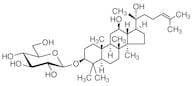
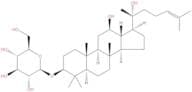
:(2R,3R,4S,5R,6R)-2-[[(10S,12S,14R,17S)-12-hydroxy-17-[(2R)-2-hydroxy-6 -methyl-hept-5-en-2-yl]-4,4,10,14,17-pentamethyl-2,3,5,6,7,8,9,11,12,1 3,15,16-dodecahydro-1H-cyclopenta[a]phenanthren-3-yl]oxy]-6-(hydroxyme thyl)oxane-3,4,5-triol
Description:
The chemical substance with the name "(2R,3R,4S,5R,6R)-2-[[[10S,12S,14R,17S)-12-hydroxy-17-[(2R)-2-hydroxy-6-methyl-hept-5-en-2-yl]-4,4,10,14,17-pentamethyl-2,3,5,6,7,8,9,11,12,13,15,16-dodecahydro-1H-cyclopenta[a]phenanthren-3-yl]oxy]-6-(hydroxymethyl)oxane-3,4,5-triol" and CAS number "112246-15-8" is a complex organic molecule characterized by multiple stereocenters and a polycyclic structure. It features a cyclopenta[a]phenanthrene core, which is indicative of its potential biological activity, particularly in the context of steroid-like compounds. The presence of hydroxyl groups suggests it may exhibit hydrophilic properties, enhancing its solubility in polar solvents. Additionally, the molecule contains a branched alkyl chain, which may influence its lipophilicity and interaction with biological membranes. Its intricate stereochemistry implies that it could have specific interactions with biological targets, making it of interest in medicinal chemistry and pharmacology. Overall, this compound's structural complexity and functional groups suggest potential applications in therapeutic contexts, although further studies would be necessary to elucidate its specific biological roles and mechanisms of action.
Formula:C36H62O8
InChI:InChI=1/C36H62O8/c1-20(2)10-9-14-36(8,42)35(7)17-16-34(6)21-11-12-25-32(3,4)26(13-15-33(25,5)22(21)18-23(38)30(34)35)44-31-29(41)28(40)27(39)24(19-37)43-31/h10,21-31,37-42H,9,11-19H2,1-8H3/t21?,22?,23-,24+,25?,26?,27+,28-,29+,30?,31-,33+,34+,35-,36+/m0/s1
Synonyms:- 20(R)-Protopanaxdiol-3-O-beta-D-glycopyranoside
- (8xi,9xi,12alpha,13xi,14beta,17beta)-12-hydroxy-17-[(2R)-2-hydroxy-6-methylhept-5-en-2-yl]-4,4,10,14,17-pentamethylgonan-3-yl beta-D-glucopyranoside
Sort by
Purity (%)
0
100
|
0
|
50
|
90
|
95
|
100
Found 7 products.
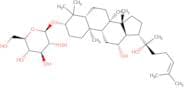
20(R)-Ginsenoside Rh2
CAS:Formula:C36H62O8Purity:>97.0%(HPLC)Color and Shape:White to Light yellow powder to crystalMolecular weight:622.8820(R)-Ginsenoside Rh2
CAS:Ginsenoside Rh2 is one of the most active components of red ginseng, controlling cancer and other metabolic diseases including osteoclast differentiation; ginsenoside Rh2 can suppress RANKL-induced osteoclast differentiation in vitro and in vivo through the regulation of c-Fos and NFATc1 expressions, not excluding the involvement of NF-κB and ERK, it is also suggested to be developed as a therapeutic drug for prevention and treatment of osteoporosis.Formula:C36H62O8Purity:20%, 95%, 98%Molecular weight:622.87320(R)-Ginsenoside Rh2
CAS:20(R)-Ginsenoside Rh2 (Ginsenoside Rh2) is a minor stereoisomer of ginsenoside Rh2, possesses matrix metalloproteinase inhibitory.Formula:C36H62O8Purity:99.58%Color and Shape:SolidMolecular weight:622.87Ref: TM-T3813
1mg46.00€5mg87.00€1mL*10mM (DMSO)119.00€10mg123.00€25mg192.00€50mg264.00€100mg378.00€200mg552.00€20(R)Ginsenoside Rh2
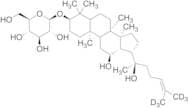
CAS:20(R)Ginsenoside Rh2 is a bioactive compound, specifically a ginsenoside, which is derived from the roots of Panax ginseng. This compound is categorized as a rare saponin, produced through the enzymatic or acidic hydrolysis of protopanaxadiol-type ginsenosides found naturally in ginseng. Its mode of action involves modulating various cellular pathways, including signaling pathways related to apoptosis, inflammation, and immune responses. It has been shown to exert anticancer effects through induction of apoptosis, inhibition of cell proliferation, and disruption of cell cycle progression in cancer cells. Additionally, it may influence the immune system by enhancing or regulating immune cell activity.Formula:C36H62O8Purity:Min. 98 Area-%Color and Shape:PowderMolecular weight:622.87 g/mol20(R)-Ginsenoside Rh2-d6
CAS:Controlled ProductFormula:C36D6H56O8Color and Shape:NeatMolecular weight:628.91