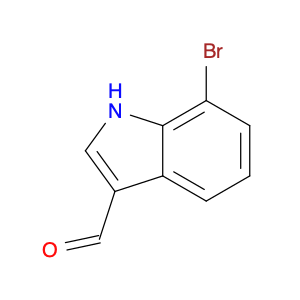
CAS 115666-21-2
:Formula:C9H6BrNO
InChI:InChI=1S/C9H6BrNO/c10-8-3-1-2-7-6(5-12)4-11-9(7)8/h1-5,11H
InChI key:MGPMWCBAOQWENZ-UHFFFAOYSA-N
SMILES:C1=CC2=C(C(=C1)Br)NC=C2C=O
Filter by
Purity percentage
0
100
|
0
|
50
|
90
|
95
|
100
Found 5 products.
- Lower prices
- Higher prices
- Lower purities
- Higher purities
- Faster estimated delivery
7-Bromo-1H-indole-3-carboxaldehyde
CAS:7-Bromo-1H-indole-3-carboxaldehydeFormula:C9H6BrNOPurity:98%Color and Shape:SolidMolecular weight:224.054047-Bromo-1H-indole-3-carbaldehyde
CAS:Formula:C9H6BrNOPurity:98%Color and Shape:SolidMolecular weight:224.05407-Bromo-1H-indole-3-carbaldehyde
CAS:7-Bromo-1H-indole-3-carbaldehydeFormula:C9H6BrNOPurity:98%Molecular weight:224.057-BROMO-1H-INDOLE-3-CARBALDEHYDE
CAS:Formula:C9H6BrNOPurity:95%Color and Shape:SolidMolecular weight:224.0577-Bromo-1H-indole-3-carbaldehyde
CAS:7-Bromo-1H-indole-3-carbaldehyde is a molecule that has been shown to enhance the production of tetrapeptides in organisms. It mimics the natural product aplysinopsin, which is found in marine organisms and also activates the enzyme mao-a. This agent has also been shown to form acetylated derivatives of triazine, which have antimicrobial activity against bacteria such as Staphylococcus aureus. 7-Bromo-1H-indole-3-carbaldehyde can be used for the synthesis of new biomimetic molecules.Formula:C9H6BrNOPurity:Min. 95%Molecular weight:224.06 g/mol