CymitQuimica logo

CAS 143537-62-6

:

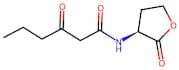
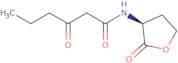
N-(B-ketocaproyl)-L-homoserine lactone

Description:
N-(B-ketocaproyl)-L-homoserine lactone, identified by its CAS number 143537-62-6, is a chemical compound that belongs to the class of homoserine lactones, which are known for their role in bacterial quorum sensing. This compound features a lactone structure, which is a cyclic ester formed from the reaction of an alcohol and a carboxylic acid. Its molecular structure includes a ketone functional group and a homoserine moiety, contributing to its biological activity. The presence of the B-ketocaproyl group suggests that it may participate in various biochemical pathways, potentially influencing microbial communication and behavior. This compound is of interest in microbiology and biochemistry due to its implications in regulating gene expression and virulence in certain bacteria. Additionally, its unique structure may offer potential applications in synthetic biology and the development of novel antimicrobial agents. As with many homoserine lactones, it may exhibit varying degrees of stability and reactivity depending on environmental conditions.
Formula:C10H15NO4
InChI:InChI=1/C10H15NO4/c1-2-3-7(12)6-9(13)11-8-4-5-15-10(8)14/h8H,2-6H2,1H3,(H,11,13)/t8-/m0/s1
SMILES:CCCC(=O)CC(=N[C@H]1CCOC1=O)O
Synonyms:
  • N-(Beta-Ketocaproyl)-Dl-Homoserine Lactone
  • 3-oxo-N-[(3S)-2-oxotetrahydrofuran-3-yl]hexanamide
Sort by

Purity (%)
0
100
|
0
|
50
|
90
|
95
|
100
Found 7 products.
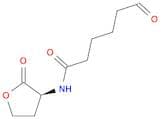
  • (S)-6-Oxo-N-(2-oxotetrahydrofuran-3-yl)hexanamide

    CAS:
    Formula:C10H15NO4
    Purity:98%
    Color and Shape:Solid
    Molecular weight:213.2304

    Ref: IN-DA007JZ3

    1g
    652.00€
    2mg
    34.00€
    10mg
    69.00€
    50mg
    133.00€
    100mg
    163.00€
    250mg
    200.00€
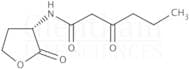
  • N-(β-Ketocaproyl)-L-hoMoserine lactone

    CAS:
    N-(β-Ketocaproyl)-L-hoMoserine lactone
    Purity:≥98%
    Molecular weight:213.23g/mol

    Ref: 54-BUP11131

    10mg
    63.00€
    25mg
    122.00€
    50mg
    199.00€
    100mg
    299.00€
    200mg
    437.00€
  • N-(β-Ketocaproyl)-L-homoserine lactone

    CAS:
    Formula:C10H15NO4
    Purity:≥ 98.0%
    Color and Shape:White solid
    Molecular weight:213.23

    Ref: 7W-GM4380

    10mg
    170.00€
    50mg
    509.00€
  • N-(β-Ketocaproyl)-L-hoMoserine lactone

    CAS:
    N-(beta-Ketocaproyl)-L-hoMoserine lactone (N-(Ketocaproyl)-L-homoserine lactone) is a component of quorum regulatory sensing and an autoinducer of P.
    Formula:C10H15NO4
    Purity:99.76%
    Color and Shape:Solid
    Molecular weight:213.23

    Ref: TM-T22374

    10mg
    47.00€
    25mg
    88.00€
    50mg
    137.00€
    100mg
    207.00€
    200mg
    306.00€
    1mL*10mM (DMSO)
    50.00€
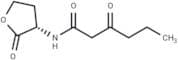
  • (S)-3-Oxo-N-(2-oxotetrahydrofuran-3-yl)hexanamide

    CAS:
    Purity:98%
    Color and Shape:Solid
    Molecular weight:213.2330017

    Ref: 10-F869766

    1g
    566.00€
    50mg
    91.00€
    100mg
    151.00€
    250mg
    247.00€
  • N-(Ketocaproyl)-L-homoserine lactone

    CAS:

    N-(Ketocaproyl)-L-homoserine lactone is a fatty acid analog of the bacterial signaling molecule homoserine lactone and a potent inducer of cell lysis. The synthesis of this analog has been demonstrated in vitro with Escherichia coli, Bacillus subtilis, and Streptococcus pneumoniae. It is active against human pathogens including Helicobacter pylori and Staphylococcus aureus as well as mammalian tissue. N-(Ketocaproyl)-L-homoserine lactone induces cell lysis by binding to the DNA polymerase to inhibit its activity and terminate DNA synthesis. This inhibition leads to an accumulation of unprocessed RNA, which induces apoptosis in bacterial cells.

    Formula:C10H15NO4
    Purity:Min. 98 Area-%
    Color and Shape:White Powder
    Molecular weight:213.23 g/mol

    Ref: 3D-FK24799

    1g
    985.00€
    2g
    1,430.00€
    100mg
    282.00€
    250mg
    472.00€
    500mg
    663.00€
  • N-(Ketocaproyl)-L-homoserine Lactone

    Controlled Product
    CAS:

    Applications An autoinducer of P. fischeri luciferase. A specific genetic regulator that is unrelated to at least one of the enzyme systems that it induces, and it acts after excretion and accumulation in the extracellular medium.
    References Eberhard, A., et al.: Biochemistry, 20, 2444 (1981)

    Formula:C10H15NO4
    Color and Shape:Neat
    Molecular weight:213.23

    Ref: TR-K180750

    25mg
    136.00€
    500mg
    927.00€