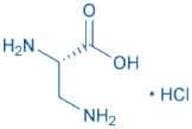
CAS 1482-97-9
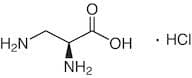
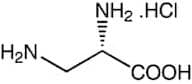
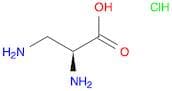
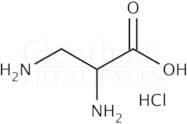
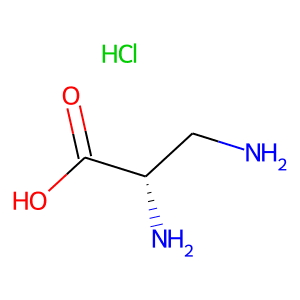
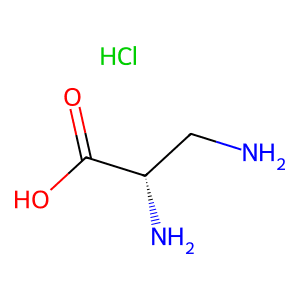
:3-Amino-L-alanine hydrochloride
Description:
3-Amino-L-alanine hydrochloride, with the CAS number 1482-97-9, is a derivative of the amino acid L-alanine, featuring an amino group at the 3-position of the carbon chain. This compound is typically encountered as a white to off-white crystalline powder and is soluble in water, which is a characteristic of many amino acids and their derivatives. It exhibits basic properties due to the presence of the amino group, allowing it to participate in various biochemical reactions. As a hydrochloride salt, it is stabilized by the presence of hydrochloric acid, enhancing its solubility and stability in aqueous solutions. 3-Amino-L-alanine is of interest in biochemical research and may have potential applications in the study of metabolic pathways, protein synthesis, and as a building block in peptide synthesis. Its role in biological systems and potential therapeutic applications are areas of ongoing investigation, particularly in relation to its structural and functional properties in proteins and enzymes.
Formula:C3H9ClN2O2
InChI:InChI=1/C3H8N2O2.ClH/c4-1-2(5)3(6)7;/h2H,1,4-5H2,(H,6,7);1H/t2-;/m0./s1
SMILES:C([C@@H](C(=O)O)N)N.Cl
Synonyms:- alpha,beta-Diaminopropionic acid HCL
- 3-Amino-L-alanine monohydrochloride
- L-3-Aminoalanine hydrochloride
- L(+)-2,3-Diaminopropionic acid HCL
- L(+)-2,3-Diaminopropionic acid hydrochloride
- L-2,3-Diaminopropionic acid monohydrochloride
- 3-Aminoalanine Hydrochloride (1:1)
- 3-amino-D-alanine hydrochloride
- (S)-(+)-2,3-Diaminopropionic Acid HCL
- H-Dap-OH.HCl
- H-Dap-OH・HCl
Sort by
Purity (%)
0
100
|
0
|
50
|
90
|
95
|
100
Found 10 products.
(S)-(+)-2,3-Diaminopropionic Acid Hydrochloride
CAS:Formula:C3H8N2O2·HClPurity:>98.0%(T)(N)Color and Shape:White to Light yellow powder to crystalMolecular weight:140.57(S)-2,3-Diaminopropionic acid monohydrochloride, 95%
CAS:This Thermo Scientific Chemicals brand product was originally part of the Alfa Aesar product portfolio. Some documentation and label information may refer to the legacy brand. The original Alfa Aesar product / item code or SKU reference has not changed as a part of the brand transition to Thermo SciFormula:C3H9ClN2O2Purity:95%Molecular weight:140.573-Amino-L-alanine, HCl
CAS:Formula:C3H9ClN2O2Purity:98%Color and Shape:SolidMolecular weight:140.5688L-2,3-Diaminopropanoic acid hydrochloride
CAS:L-2,3-Diaminopropanoic acid hydrochlorideFormula:C3H8N2O2·ClHPurity:98%Color and Shape: white to off-white solidMolecular weight:140.57g/mol2,3-Diaminopropionic acid hydrochloride
CAS:2,3-Diaminopropionic acid hydrochloridePurity:≥98%Molecular weight:140.57g/mol2,3-Diaminopropionic acid hydrochloride
CAS:2,3-Diaminopropionic acid hydrochloride (3-Amino-L-alanine hydrochloride) is a competitive cystathionase(CTH) inhibitor.Formula:C3H9ClN2O2Purity:98.77% - 99.77%Color and Shape:White Crystalline PowderMolecular weight:140.57(S)-2,3-Diaminopropanoic acid hydrochloride
CAS:Formula:C3H9ClN2O2Purity:97%Color and Shape:SolidMolecular weight:140.57L(+)-2,3-Diaminopropionic acid HCl
CAS:L(+)-2,3-Diaminopropionic acid HCl is a chiral modifier that is used in the separation of organic compounds. It has been shown to selectively interact with borate, sulfate, and hydroxyapatite. This interaction changes the physical properties of these substances by modifying their surface charge or adsorption capacity. L(+)-2,3-Diaminopropionic acid HCl has also been shown to be useful in diastereoselective reactions. The technique of elution can be used to isolate specific compounds from mixtures using this compound as a modifier. Hydrogen bonding groups and moieties on the functional group are important factors in the specificity of this interaction.END>>Formula:C3H8N2O2·HClPurity:Min. 95%Color and Shape:White PowderMolecular weight:140.57 g/molH-Dap-OH · HCl
CAS:Dap salts are used as growth inhibitors for microorganisms. Dap derivatives occur in plants. The Nβ-oxalyl derivative of Dap (β-ODAP, BOAA) which is found in the seeds of the grass pea (Lathyrus sativus), is a strong neurotoxin, whereas the α-isomer is far less toxic.Formula:C3H8N2O2·HClPurity:> 99%Color and Shape:White PowderMolecular weight:140.57