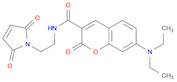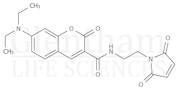
CAS 156571-46-9
:7-DIETHYLAMINO-3-((((2-MALEIMIDYL)ETHYL)AMINO) CARBONYL)COUMARIN
Description:
7-Diethylamino-3-((2-maleimidyl)ethylamino)carbonylcoumarin, identified by its CAS number 156571-46-9, is a synthetic organic compound characterized by its coumarin backbone, which is known for its fluorescent properties. This compound features a diethylamino group that enhances its solubility and fluorescence, making it useful in various biochemical applications, particularly in labeling and imaging. The presence of a maleimide group allows for specific conjugation to thiol-containing biomolecules, facilitating targeted delivery in biological systems. The carbonyl group contributes to the compound's reactivity and stability. Overall, this compound is notable for its potential applications in bioconjugation, fluorescence microscopy, and as a probe in biochemical assays, owing to its unique structural features and functional groups that enable selective interactions with biological targets. Its properties make it a valuable tool in the fields of biochemistry and molecular biology.
Formula:C20H21N3O5
InChI:InChI=1/C20H21N3O5/c1-3-22(4-2)14-6-5-13-11-15(20(27)28-16(13)12-14)19(26)21-9-10-23-17(24)7-8-18(23)25/h5-8,11-12H,3-4,9-10H2,1-2H3,(H,21,26)
InChI key:IXQPRUQVJIJUEB-UHFFFAOYSA-N
SMILES:CCN(CC)c1ccc2cc(C(=O)NCCN3C(=O)C=CC3=O)c(=O)oc2c1
Synonyms:- N-(2-(1-Maleimidyl)Ethyl)-7-(Diethylamino)Coumarin-3-Carboxamide
- Mdcc
- 7-(diethylamino)-N-[2-(2,5-dioxo-2,5-dihydro-1H-pyrrol-1-yl)ethyl]-2-oxo-2H-chromene-3-carboxamide
Filter by
Purity percentage
0
100
|
0
|
50
|
90
|
95
|
100
Found 5 products.
- Lower prices
- Higher prices
- Lower purities
- Higher purities
- Faster estimated delivery
7-(Diethylamino)-N-(2-(2,5-dioxo-2,5-dihydro-1H-pyrrol-1-yl)ethyl)-2-oxo-2H-chromene-3-carboxamide
CAS:7-(Diethylamino)-N-(2-(2,5-dioxo-2,5-dihydro-1H-pyrrol-1-yl)ethyl)-2-oxo-2H-chromene-3-carboxamideFormula:C20H21N3O5Purity:≥97%(HPLC)Molecular weight:383.4MDCC
CAS:MDCC is a multifunctional dye that serves as a crucial tool in biological experiments, assisting researchers in observing and analyzing cell structures, tracking biomolecules, evaluating cell functions, distinguishing cell types, detecting biomolecules, studying tissue pathology, and monitoring microorganisms. Its applications span from fundamental scientific research to a wide range of clinical diagnostics. Additionally, dyes are extensively utilized in traditional fields like textile dyeing and in emerging areas such as functional textile processing, food pigments, and dye-sensitized solar cells.Formula:C20H21N3O5Molecular weight:383.47-(Diethylamino)-N-(2-(2,5-dioxo-2,5-dihydro-1H-pyrrol-1-yl)ethyl)-2-oxo-2H-chromene-3-carboxamide
CAS:Formula:C20H21N3O5Purity:97%Molecular weight:383.39787-Diethylamino-3-[N-(4-maleimidoethyl)carbamoyl]coumarin
CAS:Formula:C20H21N3O5Purity:≥ 97.0%Color and Shape:White to yellow powderMolecular weight:383.402H-1-Benzopyran-3-carboxamide, 7-(diethylamino)-N-[2-(2,5-dihydro-2,5-dioxo-1H-pyrrol-1-yl)ethyl]-2-oxo-
CAS:Purity:≥97%(HPLC)Molecular weight:383.4039917