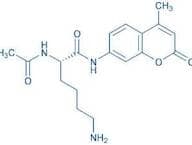
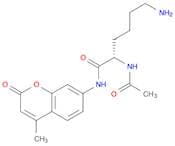
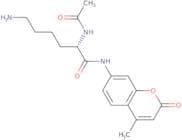
CAS 156661-42-6
:Ac-Lys-AMC
Description:
Ac-Lys-AMC, or Acetyl-Lysine-7-amido-4-methylcoumarin, is a synthetic peptide substrate commonly used in biochemical research, particularly in studies involving proteases and enzyme activity. This compound features an acetylated lysine residue linked to a 7-amido-4-methylcoumarin fluorophore, which allows for fluorescence-based detection upon cleavage by specific enzymes. The acetyl group enhances the solubility and stability of the peptide, while the lysine residue provides a site for enzymatic action. Ac-Lys-AMC is characterized by its ability to emit fluorescence when cleaved, making it a valuable tool for monitoring proteolytic activity in various biological assays. Its applications extend to drug discovery, cell biology, and understanding protein interactions. The compound is typically used in a laboratory setting, and its handling requires standard safety precautions due to its synthetic nature. Overall, Ac-Lys-AMC serves as an important reagent in the study of enzyme kinetics and protease function.
Sort by
Purity (%)
0
100
|
0
|
50
|
90
|
95
|
100
Found 4 products.
(S)-2-Acetamido-6-amino-N-(4-methyl-2-oxo-2H-chromen-7-yl)hexanamide
CAS:Formula:C18H23N3O4Purity:98.0%Molecular weight:345.3929Ac-Lys-AMC acetate salt
CAS:Ac-Lys-AMC acetate salt is a fine chemical that is used as a building block in biological research. It is a versatile building block that can be used in the synthesis of complex compounds, and as a reaction component for the production of useful intermediates. Ac-Lys-AMC acetate salt is also used as a reagent in the detection of nucleic acids.Formula:C18H23N3O4•C2H4O2Purity:Min. 98 Area-%Color and Shape:PowderMolecular weight:405.44 g/molAc-Lys-AMC
CAS:Ac-Lys-AMC (Hexanamide) is a fluorescent substrate for histone deacetylase HDACs.Formula:C18H23N3O4Purity:98%Color and Shape:SolidMolecular weight:345.39