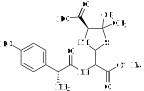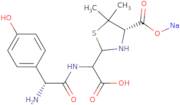
CAS 1642559-71-4
:Formula:C16H20N3NaO6S
InChI:InChI=1S/C16H21N3O6S.Na/c1-16(2)11(15(24)25)19-13(26-16)10(14(22)23)18-12(21)9(17)7-3-5-8(20)6-4-7;/h3-6,9-11,13,19-20H,17H2,1-2H3,(H,18,21)(H,22,23)(H,24,25);/q;+1/p-1/t9-,10?,11+,13?;/m1./s1
InChI key:OWFQIGGKWCUTRP-FQBITWOQSA-M
SMILES:CC1([C@@H](NC(S1)C(C(=O)O)NC(=O)[C@@H](C2=CC=C(C=C2)O)N)C(=O)[O-])C.[Na+]
Filter by
Purity percentage
0
100
|
0
|
50
|
90
|
95
|
100
Found 4 products.
- Lower prices
- Higher prices
- Lower purities
- Higher purities
- Faster estimated delivery
Amoxicillin Related Compound D
CAS:Compounds containing an unfused thiazole ring (whether or not hydrogenated) in the structureFormula:C16H20NaN3O6SColor and Shape:White PowderMolecular weight:405.09705Amoxicillin EP Impurity D Sodium Salt (Mixture of Diastereomers)
CAS:Formula:C16H20N3O6S·NaMolecular weight:382.41 22.99Amoxicillin
CAS:Amoxicillin is a β-lactam antibiotic that inhibits bacterial cell wall synthesis by binding to penicillin-binding proteins. It has antibacterial efficacy against gram-positive and gram-negative bacteria, including Streptococcus pyogenes, Staphylococcus aureus, and some strains of Enterobacteriaceae. Amoxicillin is used for the treatment of streptococcal pharyngitis, otitis media, sinusitis, pneumonia, and other respiratory tract infections. Amoxicillin can also be used in the diagnosis of bacterial infections if blood samples are taken. The matrix effect may result in false negative results with amoxicillin due to a decreased concentration in the sample.
Formula:C16H20NaN3O6SPurity:Min. 95%Molecular weight:405.4 g/mol