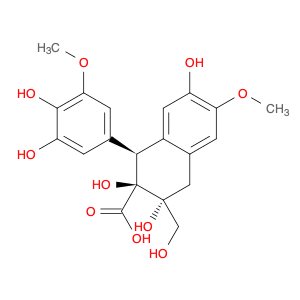
CAS 16462-65-0
:Plicatic acid
Description:
Plicatic acid, with the CAS number 16462-65-0, is a naturally occurring organic compound classified as a phenolic acid. It is primarily derived from the wood of certain species of the Western red cedar (Thuja plicata). Plicatic acid is known for its antimicrobial properties and is often studied for its potential applications in medicine and materials science. The compound exhibits a characteristic aromatic structure, which contributes to its reactivity and interaction with biological systems. It is soluble in organic solvents and has limited solubility in water, typical of many phenolic compounds. Plicatic acid is also recognized for its role in the wood's natural resistance to decay and insect damage, making it valuable in construction and woodworking. Additionally, it has been investigated for its potential health effects, including allergenic responses in sensitive individuals. Overall, plicatic acid is an important compound in both ecological and industrial contexts, reflecting the diverse roles of phenolic compounds in nature.
Formula:C20H22O10
InChI:InChI=1S/C20H22O10/c1-29-14-5-10-7-19(27,8-21)20(28,18(25)26)16(11(10)6-12(14)22)9-3-13(23)17(24)15(4-9)30-2/h3-6,16,21-24,27-28H,7-8H2,1-2H3,(H,25,26)/t16-,19+,20+/m0/s1
InChI key:InChIKey=PGFBYAIGHPJFFJ-PWIZWCRZSA-N
SMILES:C(O)(=O)[C@]1(O)[C@H](C=2C(C[C@]1(CO)O)=CC(OC)=C(O)C2)C3=CC(OC)=C(O)C(O)=C3
Synonyms:- Plicatic acid
- 2-Naphthoic acid, 1-(3,4-dihydroxy-5-methoxyphenyl)-1,2,3,4-tetrahydro-2,3,7-trihydroxy-3-(hydroxymethyl)-6-methoxy-, (1S,2S,3R)-
- 2-Naphthalenecarboxylic acid, 1-(3,4-dihydroxy-5-methoxyphenyl)-1,2,3,4-tetrahydro-2,3,7-trihydroxy-3-(hydroxymethyl)-6-methoxy-, (1S,2S,3R)-
- 2-Naphthalenecarboxylic acid, 1-(3,4-dihydroxy-5-methoxyphenyl)-1,2,3,4-tetrahydro-2,3,7-trihydroxy-3-(hydroxymethyl)-6-methoxy-, [1S-(1α,2α,3β)]-
- (1S,2S,3R)-1-(3,4-Dihydroxy-5-methoxyphenyl)-1,2,3,4-tetrahydro-2,3,7-trihydroxy-3-(hydroxymethyl)-6-methoxy-2-naphthalenecarboxylic acid
Sort by
The purity filter is not visible because current products do not have associated purity data for filtering.
Found 1 products.
2-Naphthalenecarboxylic acid, 1-(3,4-dihydroxy-5-methoxyphenyl)-1,2,3,4-tetrahydro-2,3,7-trihydroxy-3-(hydroxymethyl)-6-methoxy-, (1S,2S,3R)-
CAS:Formula:C20H22O10Molecular weight:422.3827