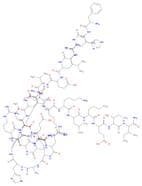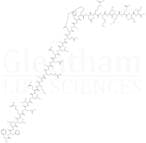
CAS 170809-51-5
:astressin
Description:
Astressin, with the CAS number 170809-51-5, is a synthetic peptide that acts as a corticotropin-releasing factor (CRF) antagonist. It is primarily used in research to study the role of CRF in stress responses and related physiological processes. Astressin is characterized by its ability to inhibit the actions of CRF, which is involved in the hypothalamic-pituitary-adrenal (HPA) axis and plays a crucial role in the body’s response to stress. The peptide is typically administered in experimental settings to investigate its effects on anxiety, depression, and other stress-related disorders. Astressin's structure consists of a sequence of amino acids that confer its biological activity, and it is often used in animal models to explore potential therapeutic applications. Due to its specific action on CRF receptors, astressin is valuable in pharmacological studies aimed at understanding stress mechanisms and developing treatments for stress-related conditions.
Formula:C161H269N49O42
InChI:InChI=1/C161H269N49O42/c1-23-27-41-96(189-145(239)107(52-59-123(217)218)199-152(246)114(71-84(13)14)207-157(251)126(85(15)16)208-147(241)108(53-60-124(219)220)197-140(234)102(47-38-66-179-161(172)173)193-151(245)112(69-82(9)10)204-153(247)113(70-83(11)12)205-155(249)116(74-94-77-175-79-181-94)201-134(228)95(163)72-92-39-30-29-31-40-92)135(229)182-88(19)130(224)186-100(45-36-64-177-159(168)169)136(230)183-89(20)131(225)188-106(51-58-122(215)216)144(238)195-104(49-56-119(165)212)146(240)202-110(67-80(5)6)149(243)185-90(21)132(226)187-103(48-55-118(164)211)143(237)196-105-50-57-121(214)176-63-35-33-44-99(192-154(248)115(73-93-76-174-78-180-93)200-133(227)91(22)184-137(105)231)142(236)206-117(75-120(166)213)156(250)194-101(46-37-65-178-160(170)171)139(233)190-98(43-32-34-62-162)141(235)203-111(68-81(7)8)150(244)191-97(42-28-24-2)138(232)198-109(54-61-125(221)222)148(242)210-128(87(18)26-4)158(252)209-127(129(167)223)86(17)25-3/h29-31,39-40,76-91,95-117,126-128H,23-28,32-38,41-75,162-163H2,1-22H3,(H2,164,211)(H2,165,212)(H2,166,213)(H2,167,223)(H,174,180)(H,175,181)(H,176,214)(H,182,229)(H,183,230)(H,184,231)(H,185,243)(H,186,224)(H,187,226)(H,188,225)(H,189,239)(H,190,233)(H,191,244)(H,192,248)(H,193,245)(H,194,250)(H,195,238)(H,196,237)(H,197,234)(H,198,232)(H,199,246)(H,200,227)(H,201,228)(H,202,240)(H,203,235)(H,204,247)(H,205,249)(H,206,236)(H,207,251)(H,208,241)(H,209,252)(H,210,242)(H,215,216)(H,217,218)(H,219,220)(H,221,222)(H4,168,169,177)(H4,170,171,178)(H4,172,173,179)/t86-,87-,88-,89-,90-,91-,95+,96-,97-,98-,99-,100-,101-,102-,103-,104-,105-,106-,107-,108-,109-,110-,111-,112-,113-,114-,115-,116-,117-,126-,127-,128-/m0/s1
Synonyms:- H-D-Phe-His-Leu-Leu-Arg-Glu-Val-Leu-Glu-Nle-Ala-Arg-Ala-Glu-Gln-Leu-Ala-Gln-cyclo(-Glu-Ala-His-Lys)-Asn-Arg-Lys-Leu-Nle-Glu-Ile-Ile-NH2
Sort by
Purity (%)
0
100
|
0
|
50
|
90
|
95
|
100
Found 5 products.
Astressin trifluoroacetate salt H-D-Phe-His-Leu-Leu-Arg-Glu-Val-Leu-Glu-Nle-Ala-Arg-Ala-Glu-Gln-Leu-Ala-Gln-cyclo(-Glu-Ala-His-Lys)-Asn-Arg-Lys-Leu-Nle-Glu-Ile-Ile-NH2 trifluoroacetate salt
CAS:Formula:C161H269N49O42Purity:96%Color and Shape:SolidMolecular weight:3563.1617Astressin
CAS:Astressin is a truncated CRF analog; binds strongly to receptor's extracellular domain, likely acting as a neutral competitive antagonist.Formula:C161H269N49O42Purity:98%Color and Shape:SolidMolecular weight:3563.16Astressin trifluoroacetate salt
CAS:Astressin trifluoroacetate salt H-D-Phe-His-Leu-Leu-Arg-Glu-Val-Leu-Glu-Nle-Ala-Arg-Ala-Glu-Gln is a cyclic peptide that has been shown to have biological properties as an inhibitor of cyclases. Astressin has shown efficacy in treating some types of autoimmune diseases and bowel diseases, although it is not effective against all types of these disorders. Astressin also has receptor activity and can induce locomotor activity. This compound has been shown to be an inhibitor of the Toll like receptor 4 (TLR4). In this role, astressin blocks the inflammatory response by preventing the binding of endotoxin to TLR4 receptors on cells.Formula:C161H269N49O42Purity:Min. 95%Molecular weight:3,563.16 g/molAstressin
CAS:The Glu³⁰ to Lys³³ lactam bridge constrains astressin in an α-helical conformation which seems to be responsible for its especially high CRF antagonist activity. Astressin is 100 times more potent than α-helical CRF (9-41) at inhibiting ACTH secretion in vitro, and more than 10 times more potent in vivo than any other CRF antagonist reported to date.Formula:C161H269N49O42Purity:97.4%Color and Shape:White PowderMolecular weight:3563.24