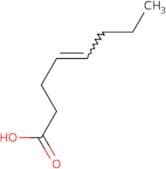
CAS 18654-81-4
:(4Z)-4-Octenoic acid
Description:
(4Z)-4-Octenoic acid, also known as 4-octenoic acid, is an unsaturated fatty acid characterized by a long hydrocarbon chain with a double bond located at the fourth carbon from the carboxylic acid end, specifically in the Z (cis) configuration. This structural feature contributes to its unique physical and chemical properties. The compound typically appears as a colorless to pale yellow liquid with a distinctive fatty odor. It is soluble in organic solvents and exhibits limited solubility in water due to its hydrophobic hydrocarbon chain. (4Z)-4-Octenoic acid is known for its reactivity, particularly in undergoing addition reactions typical of alkenes, which can be utilized in various chemical syntheses. Additionally, it can serve as a precursor in the production of surfactants, emulsifiers, and other specialty chemicals. Its applications extend to the food industry, where it may be used as a flavoring agent or in food preservation. As with many unsaturated fatty acids, it is important to handle (4Z)-4-octenoic acid with care due to potential irritant properties.
Formula:C8H14O2
InChI:InChI=1S/C8H14O2/c1-2-3-4-5-6-7-8(9)10/h4-5H,2-3,6-7H2,1H3,(H,9,10)/b5-4-
InChI key:InChIKey=PFHBCQFBHMBAMC-PLNGDYQASA-N
SMILES:C(/C=C\CCC)CC(O)=O
Synonyms:- 4-Octenoic acid, (Z)-
- (Z)-4-Octenoic acid
- (4Z)-4-Octenoic acid
- 4-Octenoic acid, (4Z)-
Sort by
Purity (%)
0
100
|
0
|
50
|
90
|
95
|
100
Found 3 products.
(Z)-4-Octenoic acid
CAS:4-Octenoic acid is a fatty acid that is found in human urine and may be used to diagnose metabolic diseases. The presence of this compound in the urine indicates that there has been incomplete metabolism of fatty acids, which can lead to a variety of metabolic disorders. 4-Octenoic acid is not found in normal human plasma. It is excreted by the kidney and detected in the urine after being converted from other compounds such as acetylcarnitine or acylcarnitines. 4-Octenoic acid levels are increased when there are deficiencies in carnitine and carnitine esters, which can lead to an increased risk for cardiovascular disease and muscle damage.
Formula:C8H14O2Purity:Min. 95%Color and Shape:Clear LiquidMolecular weight:142.2 g/mol