CAS 19660-77-6
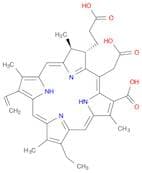
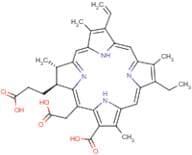
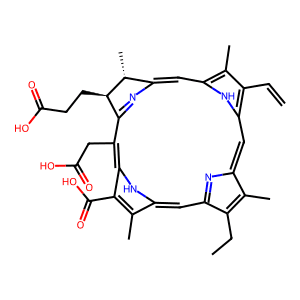
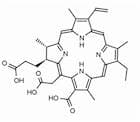
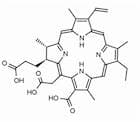
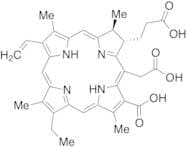
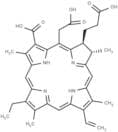
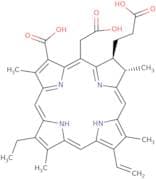
:Chlorin e6
Description:
Chlorin e6, also known as chlorin e6 or chlorin e6 (C6H6N4O4), is a chlorophyll derivative that exhibits unique photophysical and photochemical properties, making it valuable in various applications, particularly in photodynamic therapy (PDT) and as a photosensitizer. This compound is characterized by its ability to absorb light in the visible spectrum, particularly in the red region, which enhances its effectiveness in therapeutic applications. Chlorin e6 is known for its high singlet oxygen generation efficiency upon light activation, which is crucial for inducing cytotoxic effects in targeted cancer cells. Additionally, it possesses a relatively high solubility in organic solvents, which facilitates its use in formulations for medical and research purposes. Its structural features include a central porphyrin-like core with various substituents that influence its reactivity and interaction with biological systems. Overall, Chlorin e6 is a promising compound in the fields of medicine and biotechnology, particularly for its potential in cancer treatment and imaging applications.
Formula:C34H36N4O6
InChI:InChI=1S/C34H36N4O6/c1-7-19-15(3)23-12-25-17(5)21(9-10-29(39)40)32(37-25)22(11-30(41)42)33-31(34(43)44)18(6)26(38-33)14-28-20(8-2)16(4)24(36-28)13-27(19)35-23/h7,12-14,17,21,35,38H,1,8-11H2,2-6H3,(H,39,40)(H,41,42)(H,43,44)/b23-12?,24-13-,25-12-,26-14-,27-13?,28-14?,32-22?,33-22-/t17-,21-/m0/s1
InChI key:InChIKey=VAJLRIOJDADNAT-QXILTCMVSA-N
SMILES:C(C(O)=O)C1=C2[C@@H](CCC(O)=O)[C@H](C)C(=N2)C=C3NC(C(C=C)=C3C)=CC4=NC(=CC=5NC1=C(C(O)=O)C5C)C(CC)=C4C
Synonyms:- (17S,18S)-18-(2-carboxyethyl)-20-(carboxymethyl)-12-ethenyl-7-ethyl-3,8,13,17-tetramethyl-17,18-dihydroporphyrin-2-carboxylic acid
- (7S,8S)-3-Carboxy-5-(carboxymethyl)-13-ethenyl-18-ethyl-7,8-dihydro-2,8,12,17-tetramethyl-21H,23H-porphine-7-propanoic acid
- 18-(2-Carboxyethyl)-20-(Carboxymethyl)-12-Ethenyl-7-Ethyl-3,8,13,17-Tetramethyl-17,18-Dihydroporphyrin-2-Carboxylic Acid
- 2-Porphinepropionic acid, 18-carboxy-20-(carboxymethyl)-13-ethyl-2β,3-dihydro-3β,7,12,17-tetramethyl-8-vinyl-
- 21H,23H-Porphine-2-propanoic acid, 18-carboxy-20-(carboxymethyl)-8-ethenyl-13-ethyl-2,3-dihydro-3,7,12,17-tetramethyl-,(2S-trans)-
- 21H,23H-Porphine-7-propanoic acid, 3-carboxy-5-(carboxymethyl)-13-ethenyl-18-ethyl-7,8-dihydro-2,8,12,17-tetramethyl-, (7S,8S)-
- Chlorin a<sub>6</sub>
- Chlorin e6
- Chlorin e<sub>6</sub>
- Chlorine a<sub>6</sub>
- Chlorine e<sub>6</sub>
- Chlorophyllin
- Photochlorine
- Photolon
- Phytochlorin
- Phytochlorin e<sub>6</sub>
- Phytochlorine e<sub>6</sub>
- (2S-trans)-18-Carboxy-20-(carboxymethyl)-13-ethyl-2,3-dihydro-3,7,12,17-tetramethyl-8-vinyl-21H,23H-porphine-2-propionic acid
- See more synonyms
Sort by
Purity (%)
0
100
|
0
|
50
|
90
|
95
|
100
Found 9 products.
21H,23H-Porphine-7-propanoic acid,3-carboxy-5-(carboxymethyl)-13-ethenyl-18-ethyl-7,8-dihydro-2,8,12,17-tetramethyl-, (7S,8S)-
CAS:Formula:C34H38N4O6Purity:90%Color and Shape:SolidMolecular weight:598.6887Chlorin e6
CAS:Chlorin e6Formula:C34H36N4O6Purity:90%Color and Shape: light brown to black solidMolecular weight:596.67g/molChlorin E6
CAS:Controlled ProductApplications Chlorin E6 is a photosensitizer.The conjugates of gold nanorods and chlorin e6 enhance the fluorescence detection and photodynamic therapy (PDT) of cancers.
References Schmidt-Erfurth, U., et al.: Brit. J. Cancer, 75, 54 (1997); Huang, X., et al.: Phys. Chem. Chem. Phys., 15, 15727 (2013)Formula:C34H36N4O6Color and Shape:NeatMolecular weight:596.67Chlorin E6
CAS:CE6 is a photosensitizer effective against tumors with light exposure, shown successful in mouse models and human trials for bronchial and lung cancer.Formula:C34H36N4O6Purity:90.964% - 95.05%Color and Shape:SolidMolecular weight:596.67Chlorin e6
CAS:Chlorin e6 is a photosensitizer, which is derived from chlorophyll, specifically the breakdown products of chlorophyll a extracted from plants and algae. It has a significant absorption in the red and near-infrared region of the electromagnetic spectrum, facilitating its use in photodynamic therapy (PDT). Upon activation by light, chlorin e6 produces reactive oxygen species, including singlet oxygen, which can induce cell death. This photochemical mechanism allows for the targeted destruction of cancer cells when used in oncological settings.Formula:C34H36N4O6Purity:90%MinColor and Shape:Dark Blue-Green Or Dark Purple SolidMolecular weight:596.67 g/mol