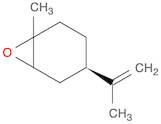
CAS 203719-54-4
:Formula:C10H16O
InChI:InChI=1S/C10H16O/c1-7(2)8-4-5-10(3)9(6-8)11-10/h8-9H,1,4-6H2,2-3H3/t8-,9?,10?/m1/s1
InChI key:CCEFMUBVSUDRLG-XNWIYYODSA-N
SMILES:CC(=C)[C@@H]1CCC2(C(C1)O2)C
Filter by
Purity percentage
0
100
|
0
|
50
|
90
|
95
|
100
Found 7 products.
- Lower prices
- Higher prices
- Lower purities
- Higher purities
- Faster estimated delivery
(+)-Limonene 1,2-epoxide
CAS:(+)-Limonene 1,2-epoxideFormula:C10H18OPurity:95%Color and Shape:SolidMolecular weight:154.24931(4R)-4-Isopropyl-1-methyl-7-oxabicyclo[4.1.0]heptane
CAS:Formula:C10H18OPurity:95.0%Molecular weight:154.253(4R)-4-Isopropyl-1-methyl-7-oxabicyclo[4.1.0]heptane
CAS:Formula:C10H16OPurity:96%Color and Shape:LiquidMolecular weight:152.2334(4R)-1-Methyl-4-(prop-1-en-2-yl)-7-oxabicyclo[4.1.0]heptane
CAS:(4R)-1-Methyl-4-(prop-1-en-2-yl)-7-oxabicyclo[4.1.0]heptaneFormula:C10H16OPurity:97% (mixture of isomers)Molecular weight:152.23(+)-Limonene oxide,mixture of cis/trans isomers
CAS:Limonene oxide is a mixture of cis/trans isomers that belongs to the group of aziridines. It can be produced by catalytic ring-opening polymerization, or by copolymerization with other monomers. Limonene oxides are obtained as a mixture of cis and trans isomers. The trans isomer has been reported to have a shorter reaction time and higher selectivity than the cis isomer. Limonene oxide can be used in the production of polycarbonates, which are used in many different products such as containers for food and drink, packaging materials, and electronics. Limonene oxide can also be used for the synthesis of epoxides and n-oxides. These compounds are used in medical applications such as anti-cancer drugs, antibiotics, antifungals, antivirals, contraceptives, and more.Formula:C10H16OPurity:Min. 95%Molecular weight:152.23 g/mol(4R)-1-Methyl-4-(prop-1-en-2-yl)-7-oxabicyclo[4.1.0]heptane
CAS:Purity:97%Molecular weight:152.2369995(R)-Limonene 1,2-epoxide (Mixture of Diastereomers)
CAS:Controlled ProductApplications Oxidized Limonene, a common reagent used in the preparation of fragrant compounds.
References D'Souza, A., et al.: J. Nat. Prod., 67, 700 (2004), Bergstroem, M., et al.: Chem. Res. Toxicol., 19, 760 (2006), Krishnamurthy, M., et al.: Bioorg. Med. Chem., 16, 6489 (2008),Formula:C10H16OColor and Shape:NeatMolecular weight:152.23