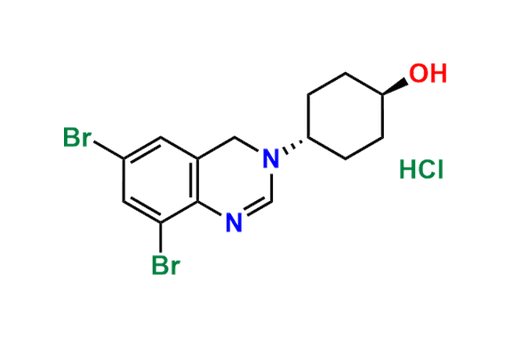
CAS 2356152-56-0
:Formula:C14H17Br2ClN2O
InChI:InChI=1S/C14H16Br2N2O.ClH/c15-10-5-9-7-18(8-17-14(9)13(16)6-10)11-1-3-12(19)4-2-11;/h5-6,8,11-12,19H,1-4,7H2;1H
InChI key:FFENEVSGUVRJMN-UHFFFAOYSA-N
SMILES:C1CC(CCC1N2CC3=C(C(=CC(=C3)Br)Br)N=C2)O.Cl
Filter by
Purity percentage
0
100
|
0
|
50
|
90
|
95
|
100
Found 3 products.
- Lower prices
- Higher prices
- Lower purities
- Higher purities
- Faster estimated delivery
trans-4-(6,8-Dibromoquinazolin-3(4H)-yl)cyclohexanol Hydrochloride
CAS:Controlled ProductFormula:C14H16Br2N2O·ClHColor and Shape:NeatMolecular weight:424.566,8-Dibrom-3-trans-4-hydroxycyclohexyl-3,4-dihydroquinazoline Hydrochloride
CAS:Formula:C14H16Br2N2OHClMolecular weight:388.10 : 36.46trans-4-(6,8-Dibromo-3(4H)-quinazolinyl)cyclohexanol hydrochloride
CAS:Trans-4-(6,8-Dibromo-3(4H)-quinazolinyl)cyclohexanol hydrochloride is a potent kinase inhibitor that has shown promising results in anticancer research. It specifically targets human kinases and induces apoptosis in cancer cells. This compound has been identified as a potential therapeutic agent for the treatment of various types of tumors, including those found in breast, lung, and prostate cancers. In addition to its medicinal properties, trans-4-(6,8-Dibromo-3(4H)-quinazolinyl)cyclohexanol hydrochloride can be detected in urine samples and serves as an important tool for researchers studying protein kinases and their inhibitors. This analog of Chinese medicine is a valuable addition to any laboratory seeking to advance cancer research through the development of new therapies.Formula:C14H16Br2N2O•HClPurity:Min. 95%Molecular weight:424.56 g/molRef: 3D-ID183211
Discontinued product