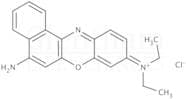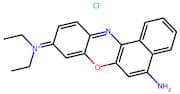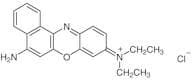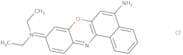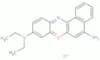
CAS 2381-85-3
:Nile Blue
Description:
Nile Blue, with the CAS number 2381-85-3, is a synthetic dye belonging to the class of phenothiazine derivatives. It is primarily known for its vibrant blue color and is often used in biological staining applications, particularly in microscopy to visualize cellular structures. Nile Blue exhibits distinct characteristics, including its ability to intercalate with nucleic acids, making it useful for differentiating between viable and non-viable cells. The dye is soluble in organic solvents and has limited solubility in water, which can influence its application in various experimental settings. Its fluorescence properties are also notable, as it can emit light upon excitation, allowing for enhanced imaging techniques. Additionally, Nile Blue has been studied for its potential applications in photodynamic therapy due to its ability to generate reactive oxygen species upon light activation. However, safety considerations must be taken into account, as with many synthetic dyes, due to potential toxicity and environmental impact. Overall, Nile Blue is a versatile compound with significant utility in both research and clinical settings.
Formula:C20H20N3O·Cl
InChI:InChI=1S/C20H20N3O.ClH/c1-3-23(4-2)13-9-10-17-18(11-13)24-19-12-16(21)14-7-5-6-8-15(14)20(19)22-17;/h5-12H,3-4,21H2,1-2H3;1H/q+1;/p-1
InChI key:InChIKey=XJCPMUIIBDVFDM-UHFFFAOYSA-M
SMILES:NC1=C2C(=C3C([O+]=C4C(=N3)C=CC(N(CC)CC)=C4)=C1)C=CC=C2.[Cl-]
Synonyms:- Nile Blue
- C.I. Basic Blue 12
- Benzo[a]phenoxazin-7-ium, 5-amino-9-(diethylamino)-, chloride
- Benzo[a]phenoxazin-7-ium, 5-amino-9-(diethylamino)-, chloride (1:1)
- C.I. 51180
Sort by
Purity (%)
0
100
|
0
|
50
|
90
|
95
|
100
Found 7 products.
Benzo[a]phenoxazin-7-ium, 5-amino-9-(diethylamino)-, chloride
CAS:Formula:C20H20ClN3OColor and Shape:SolidMolecular weight:353.8453Nile Blue chloride
CAS:Nile Blue chlorideFormula:C20H20N3O·ClColor and Shape: dark brownish green powderMolecular weight:353.84529g/molBasic Blue 12
CAS:Formula:C20H20ClN3OColor and Shape:Green to Dark green powder to crystalMolecular weight:353.85Nile blue chloride
CAS:Nile blue chloride is a dye used in wastewater treatment. It can be used to measure the dry weight of a sample of material. Nile blue chloride has been shown to be a reliable fluorescent probe for bacterial detection in cell culture and tissue culture, as well as for the detection of infectious diseases. This compound has also been shown to have an effect on the oxygen transport in living cells, which may be due to its high affinity for fatty acids.
Formula:C20H20N3OClPurity:Min. 95%Color and Shape:PowderMolecular weight:353.85 g/molNile Blue Chloride
CAS:Formula:C20H20N3OClColor and Shape:Dark brownish black , greenish black ,bluish black, PowderMolecular weight:732.85
![Benzo[a]phenoxazin-7-ium, 5-amino-9-(diethylamino)-, chloride](/_next/image/?url=https%3A%2Fstatic.cymitquimica.com%2Fproducts%2FIN%2Fthumb%2FDA00I4LX.jpg&w=3840&q=75)