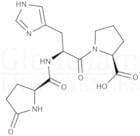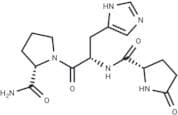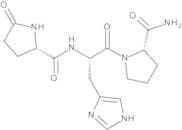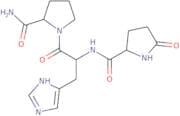
CAS 24305-27-9
:TSH-releasing hormone
Description:
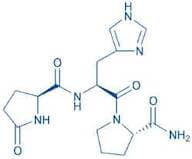
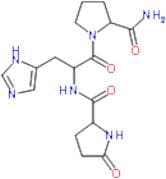
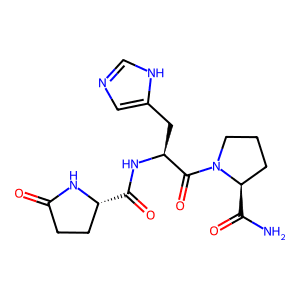
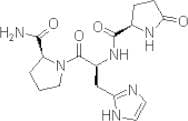
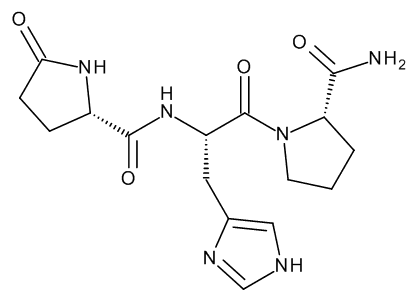
Thyrotropin-releasing hormone (TRH), also known as TSH-releasing hormone, is a tripeptide hormone composed of three amino acids: pyroglutamic acid, histidine, and proline. It plays a crucial role in the regulation of thyroid function by stimulating the release of thyroid-stimulating hormone (TSH) from the anterior pituitary gland. TRH is synthesized in the hypothalamus and is involved in the hypothalamic-pituitary-thyroid axis, influencing metabolic processes and energy homeostasis. The CAS number 24305-27-9 specifically identifies this peptide, which is typically found in a solid or lyophilized form for research and therapeutic applications. TRH is water-soluble and can be administered via various routes, including intravenous or subcutaneous injection. Its biological activity is mediated through specific receptors in the pituitary gland, leading to downstream effects on thyroid hormone production. Additionally, TRH has been studied for its potential roles in various physiological and pathological conditions, including its effects on mood and stress responses.
Formula:C16H22N6O4
InChI:InChI=1S/C16H22N6O4/c17-14(24)12-2-1-5-22(12)16(26)11(6-9-7-18-8-19-9)21-15(25)10-3-4-13(23)20-10/h7-8,10-12H,1-6H2,(H2,17,24)(H,18,19)(H,20,23)(H,21,25)/t10-,11-,12-/m0/s1
InChI key:InChIKey=XNSAINXGIQZQOO-SRVKXCTJSA-N
SMILES:C([C@H](CC1=CN=CN1)NC(=O)[C@@H]2CCC(=O)N2)(=O)N3[C@H](C(N)=O)CCC3
Synonyms:- (Pyro)-<span class="text-smallcaps">L</smallcap>-glutamic acid-<smallcap>L</smallcap>-histidine-<smallcap>L</span>-proline-NH<sub>2</sub>
- (Pyro)-L-glutamic acid-L-histidine-L-proline-NH2
- 252: PN: WO2010033207 SEQID: 378 claimed protein
- 5-Oxo-<span class="text-smallcaps">L</smallcap>-prolyl-<smallcap>L</smallcap>-histidyl-<smallcap>L</span>-prolinamide
- 83: PN: US20090175821 PAGE: 403 claimed protein
- <span class="text-smallcaps">L</smallcap>-Prolinamide, 5-oxo-<smallcap>L</smallcap>-prolyl-<smallcap>L</span>-histidyl-
- <span class="text-smallcaps">L</smallcap>-Pyroglutamyl-<smallcap>L</smallcap>-histidyl-<smallcap>L</span>-prolinamide
- <span class="text-smallcaps">L</smallcap>-Pyroglutamyl-<smallcap>L</smallcap>-histidyl-<smallcap>L</span>-proline amide
- Abbott 38579
- Antepan
- Fda 1725
- L-Pyroglutamyl-L-histidyl-L-prolinamide
- L-Pyroglutamyl-L-histidyl-L-proline amide
- Lopremone
- Prem
- Protirelin
- Protirelina
- Protireline
- Relefact TRH
- Rifathyroin
- Rifotironin
- Ro 8-6270/9
- Stimu TSH
- Synthetic TRF
- Synthetic TRH
- Synthetic TSH-releasing factor
- Synthetic TSH-releasing hormone
- Synthetic thyrotropin-releasing factor
- Synthetic thyrotropin-releasing hormone
- TRF
- TRH
- TSH-releasing factor
- TSH-releasing hormone
- Thypinone
- Thyrefact
- Thyroid releasing hormone
- Thyroid-stimulating hormone-releasing factor
- Thyroliberin
- Thyrotropic hormone-releasing factor
- Thyrotropic hormone-releasing hormone
- Thyrotropic releasing hormone
- Thyrotropic-releasing factor
- Thyrotropin-releasing factor
- Thyrotropin-releasing hormone
- Tsh-Rf
- L-Prolinamide, 5-oxo-L-prolyl-L-histidyl-
- See more synonyms
Sort by
Purity (%)
0
100
|
0
|
50
|
90
|
95
|
100
Found 14 products.
Thyrotropin-Releasing Hormone
CAS:Thyrotropin-Releasing HormoneFormula:C16H22N6O4Color and Shape:White, Lyophilized powderMolecular weight:362.38TRH
CAS:TRH exhibits a variety of biological effects, when injected into humans or animals. Its physiological role appears to be the stimulation of thyrotropin (TSH) and prolactin (PRL) release from the anterior pituitary. Though it was first identified in the hypothalamus as a regulator of the pituitary-thyroid axis, TRH was detected as well by Luo et al. in pancreatic β-cells co-localized with insulin. Application of the hormone reverted hyperglycemia in rats. Moreover, TRH plays an important role in the control of human hair-growth and hair follicle pigmentation.Formula:C16H22N6O4Purity:98.6%Color and Shape:Whitish PowderMolecular weight:362.39L-Pyroglutamyl-L-Histidyl-L-Prolinamide
CAS:L-Pyroglutamyl-L-Histidyl-L-ProlinamidePurity:98%Molecular weight:362.38g/molProtirelin
CAS:Protirelin (Thyroliberin) is a tripeptide that stimulates the release of thyrotropin and prolactin.Formula:C16H22N6O4Purity:99.76%Color and Shape:White Or Almost White PowderMolecular weight:362.38Protirelin
CAS:Formula:C16H22N6O4Purity:95%~99%Color and Shape:White to Off-white PowderMolecular weight:362.38Thyrotropin-Releasing Hormone
CAS:Controlled ProductApplications Thyrotropin-Releasing Hormone is a hypothalamic hypophysiotropic neuropeptide, which has the ability to stimulate the release of thyroid-stimulating hormone in mammals. It is proven that Thyrotropin-Releasing Hormone can be used to accelerate wound healing.
References Kanasaki, H., et al.: Neuropeptides., 54, 73 (2015); Nie, C., et al.: J. Surg. Res., 189, 364 (2014);Formula:C16H22N6O4Color and Shape:Off-WhiteMolecular weight:362.38L-Pyroglutamyl-L-histidyl-L-prolinamide
CAS:L-Pyroglutamyl-L-histidyl-L-prolinamide (PGC) is a pyrrolidine that is used for the treatment of neurologic disorders. It has been shown to be effective in treating depression and a number of other neurologic disorders, including Parkinson's disease, Alzheimer's disease, and epilepsy. PGC has also been shown to have an antidepressant effect in women with depression who are pregnant or have recently given birth. In addition, it has been found to be clinically effective in the treatment of symptoms associated with Parkinson’s Disease. PGC is not absorbed into the bloodstream and must be injected directly into muscle tissue or fat cells in order to produce its therapeutic effects.Formula:C16H22N6O4Purity:Min. 95%Color and Shape:White PowderMolecular weight:362.38 g/molThyrotropin Releasing Hormone (TRH) (Human, Ovine, Porcine, Rat)
CAS:Thyrotropin releasing hormone (TRH) is a peptide that is produced in the hypothalamus. It has various functions, including being an activator of thyroid stimulating hormone (TSH) and releasing growth hormone from the anterior pituitary gland. TRH also has anti-inflammatory effects and is used as a research tool in cell biology. TRH binds to receptors on cells and can activate ion channels, which causes an influx of calcium ions into cells. This leads to the activation of protein kinases, which are important in cell signaling pathways. TRH also interacts with other proteins, such as receptor tyrosine kinases and G-protein coupled receptors.Formula:C16H22N6O4Purity:Min. 95%Molecular weight:362.38 g/molThyrotropin Releasing Hormone (TRH) (Human, Ovine, Porcine, Rat)
CAS:Thyrotropin Releasing Hormone (TRH) is a hormone that stimulates the release of thyroid hormones. TRH has been used to diagnose and treat conditions such as autoimmune diseases, infectious diseases, and thyroid disease. It is also used in the treatment of patients with hypothyroidism who are not responding to levothyroxine therapy. TRH is administered intravenously or intramuscularly. This drug is primarily used for diagnostic purposes in women who have symptoms of hyperthyroidism but normal serum levels of TSH and thyroxine levels. TRH administration can result in a rise in serum prolactin levels, which may be useful for diagnosis of the condition hyperprolactinemia.Formula:C16H22N6O4•H2OPurity:Min. 95%Molecular weight:380.4 g/mol