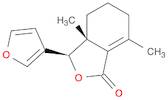
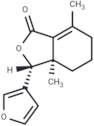
CAS 28808-62-0
:Fraxinellone
Description:
Fraxinellone is a naturally occurring chemical compound classified as a coumarin derivative. It is primarily extracted from the bark of the Fraxinus species, particularly the ash tree. This compound is characterized by its unique bicyclic structure, which contributes to its biological activity. Fraxinellone exhibits various pharmacological properties, including anti-inflammatory, antioxidant, and antimicrobial effects, making it of interest in medicinal chemistry and natural product research. Its molecular formula typically includes carbon, hydrogen, and oxygen atoms, reflecting its organic nature. The compound is often studied for its potential therapeutic applications, particularly in traditional medicine systems. Additionally, fraxinellone's solubility and stability can vary depending on the solvent and environmental conditions, which is crucial for its extraction and application in formulations. Overall, fraxinellone represents a significant compound in the field of natural products, with ongoing research aimed at elucidating its mechanisms of action and potential health benefits.
Formula:C14H16O3
InChI:InChI=1S/C14H16O3/c1-9-4-3-6-14(2)11(9)13(15)17-12(14)10-5-7-16-8-10/h5,7-8,12H,3-4,6H2,1-2H3/t12-,14+/m0/s1
InChI key:InChIKey=XYYAFLHHHZVPRN-GXTWGEPZSA-N
SMILES:C[C@]12[C@@H](OC(=O)C1=C(C)CCC2)C=3C=COC3
Synonyms:- (3R,3aR)-3-(3-Furanyl)-3a,4,5,6-tetrahydro-3a,7-dimethyl-1(3H)-isobenzofuranone
- (3R,3aR)-3-(3-Furyl)-3a,7-dimethyl-3a,4,5,6-tetrahydro-2-benzofuran-1(3H)-one
- (3R,3aR)-3-(furan-3-yl)-3a,7-dimethyl-3a,4,5,6-tetrahydro-2-benzofuran-1(3H)-one
- 1(3H)-Isobenzofuranone, 3-(3-furanyl)-3a,4,5,6-tetrahydro-3a,7-dimethyl-, (3R-cis)-
- 1(3H)-isobenzofuranone, 3-(3-furanyl)-3a,4,5,6-tetrahydro-3a,7-dimethyl-, (3R,3aR)-
- Phthalide, 3-(3-furyl)-3a,4,5,6-tetrahydro-3a,7-dimethyl-
- Fraxinellone
Filter by
Purity percentage
0
100
|
0
|
50
|
90
|
95
|
100
Found 14 products.
- Lower prices
- Higher prices
- Lower purities
- Higher purities
- Faster estimated delivery
Fraxinellone
CAS:Formula:C14H16O3Purity:>96.0%(GC)Color and Shape:White to Almost white powder to crystalMolecular weight:232.28(3R,3aR)-3-(Furan-3-Yl)-3A,7-Dimethyl-3A,4,5,6-Tetrahydroisobenzofuran-1(3H)-One
CAS:(3R,3aR)-3-(Furan-3-Yl)-3A,7-Dimethyl-3A,4,5,6-Tetrahydroisobenzofuran-1(3H)-OneFormula:C14H16O3Purity:99%Molecular weight:232.28Fraxinellone (Standard)
CAS:Fraxinellone (Standard) is a reference standard for research and analysis in studies involving Fraxinellone. 1. Fraxinellone significantly reduced weight loss and diarrhea in mice and alleviated the macroscopic and microscopic signs of the disease. 2. Fraxinellone exhibited a variety of insecticidal activities including feeding-deterrent activity, inhibition of growth, and larvicidal activity. 3. Fraxinellone has effect in the midgut metabolism of Mythimna separata (M. separata), via protease (especially the weak alkaline trypsin-like enzyme), carboxylesterase and glutathione S-transferase.Formula:C14H16O3Molecular weight:232.275Fraxinellone
CAS:1.Formula:C14H16O3Purity:99.35% - 99.88%Color and Shape:Yellow SolidMolecular weight:232.275Fraxinellone
CAS:(3R,3aR)-3-(Furan-3-yl)-3a,7-dimethyl-3a,4,5,6-tetrahydroisobenzofuran-1(3H)-oneFormula:C14H16O3Purity:99%Molecular weight:232.28Fraxinellone
CAS:LactoneFormula:C14H16O3Purity:≥ 95.0 % (HPLC)Color and Shape:PowderMolecular weight:232.28Fraxinellone
CAS:Controlled ProductApplications Fraxinellone is an insecticidal agent, inhibiting growth of larvae, used in the treatment and protection of crops and produce. Also, a naturally occurring compound used in the treatment of tumors.
Not a dangerous good if item is equal to or less than 1g/ml and there is less than 100g/ml in the package
References Lu, M. et al.: Mol. 18, 2754 (2013); Guo, Y. et al.: J. Agri. Food. Chem., 61, 11937 (2013);Formula:C14H16O3Color and Shape:NeatMolecular weight:232.28Fraxinellone
CAS:Fraxinellone is a naturally occurring sesquiterpenoid lactone, which is derived from the plant species Dictamnus dasycarpus, commonly known as the burning bush. It exhibits its mode of action through the disruption of calcium ion channels, leading to neurotoxic effects in target organisms. This interaction with calcium channel pathways is crucial for its bioactivity, influencing both insecticidal and potential therapeutic effects.Purity:Min. 95%Ref: 3D-FF73946
Discontinued product