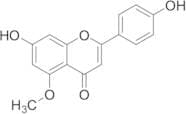
CAS 29376-68-9
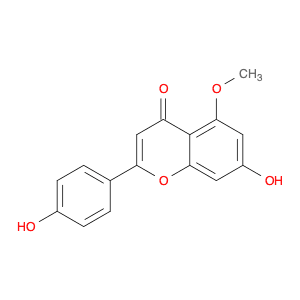
:4H-1-Benzopyran-4-one,7-hydroxy-2-(4-hydroxyphenyl)-5-methoxy-
Description:
4H-1-Benzopyran-4-one, 7-hydroxy-2-(4-hydroxyphenyl)-5-methoxy- is a chemical compound that belongs to the class of flavonoids, specifically a type of chromone. This compound features a benzopyran structure, which consists of a fused benzene and pyran ring, contributing to its aromatic properties. The presence of hydroxyl groups (-OH) at specific positions enhances its potential for hydrogen bonding and increases its solubility in polar solvents. The methoxy group (-OCH3) further influences its reactivity and stability. This compound is of interest in various fields, including medicinal chemistry, due to its potential antioxidant, anti-inflammatory, and anticancer properties. Its structural characteristics may also allow for interactions with biological targets, making it a candidate for further pharmacological studies. Additionally, the compound's unique functional groups can affect its spectral properties, making it suitable for analytical techniques such as UV-Vis spectroscopy and NMR. Overall, 4H-1-Benzopyran-4-one, 7-hydroxy-2-(4-hydroxyphenyl)-5-methoxy- exhibits a combination of chemical properties that may contribute to its biological activity.
Formula:C16H12O5
Synonyms:- Flavone,4',7-dihydroxy-5-methoxy- (8CI)
- Apigenin 5-O-monomethyl ether
- Apigenin-5-methyl ether
- Thevetiaflavone
Sort by
Purity (%)
0
100
|
0
|
50
|
90
|
95
|
100
Found 5 products.
4H-1-Benzopyran-4-one, 7-hydroxy-2-(4-hydroxyphenyl)-5-methoxy-
CAS:Formula:C16H12O5Purity:98%Color and Shape:SolidMolecular weight:284.2635Thevetiaflavone
CAS:Thevetiaflavone, a natural flavonoid from W. indica, blocks LDH leakage, boosting cell survival.Formula:C16H12O5Purity:98%Color and Shape:SolidMolecular weight:284.26Thevetiaflavone
CAS:Thevetiaflavone is a bioactive phytochemical that is found in Thevetia peruviana, a plant native to South America. This compound inhibits the activity of P-glycoprotein, which is an important protein for the transport of many drugs. Thevetiaflavone has been shown to increase mitochondrial membrane potential and inhibit neuronal death in fetal bovine brain cells, as well as protect against oxidative damage in rat brains. It also has anti-inflammatory properties and can reduce the uptake of acetate by inhibiting carthamus tinctorius (a type of yeast). Thevetiaflavone may be useful for treating ischemic brain damage.Formula:C16H12O5Purity:Min. 95%Color and Shape:PowderMolecular weight:284.26 g/mol