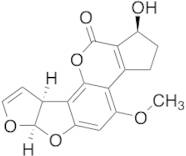
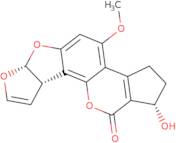
![(1S,6aR,9aS)-2,3,6a,9a-Tetrahydro-1-hydroxy-4-methoxycyclopenta[c]furo[3′,2′:4,5]furo[2,3-h][1]ben…](https://static.cymitquimica.com/cas-image/thumb-webp/300775-1s-6ar-9as-236a-9a-tetrahydro-1-hydroxy-4-methoxycyclopenta-c-furo-32-45-furo-23-h-1-benzopyran-11-1h-one.webp)
CAS 29611-03-8
:(1S,6aR,9aS)-2,3,6a,9a-Tetrahydro-1-hydroxy-4-methoxycyclopenta[c]furo[3′,2′:4,5]furo[2,3-h][1]benzopyran-11(1H)-one
- (1R,6aS,9aS)-1-hydroxy-4-methoxy-2,3,6a,9a-tetrahydrocyclopenta[c]furo[3',2':4,5]furo[2,3-h]chromen-11(1H)-one
- (1S,6aR,9aS)-1-hydroxy-4-methoxy-2,3,6a,9a-tetrahydrocyclopenta[c]furo[3',2':4,5]furo[2,3-h]chromen-11(1H)-one
- (1S,6aR,9aS)-2,3,6a,9a-Tetrahydro-1-hydroxy-4-methoxycyclopenta[c]furo[3′,2′:4,5]furo[2,3-h][1]benzopyran-11(1H)-one
- (1S-(1alpha,6abeta,9abeta))-2,3,6a,9a-Tetrahydro-1-hydroxy-4-methoxycyclopenta(c)furo(3',2':4,5)furo(2,3-h)(1)benzopyran-11(1H)-one
- AFL
- Aflatoxicol
- Aflatoxicol natural epimer
- Aflatoxin R<sub>0</sub>
- Aflatoxin Ro
- Ccris 11
- Cyclopenta(c)furo(3',2':4,5)furo(2,3-h)(1)benzopyran-11(1H)-one, 2,3,6a,9a-tetrahydro-1-hydroxy-4-methoxy-, (1S,6aR,9aS)-
- Cyclopenta[c]furo[3′,2′:4,5]furo[2,3-h][1]benzopyran-11(1H)-one, 2,3,6a,9a-tetrahydro-1-hydroxy-4-methoxy-
- Cyclopenta[c]furo[3′,2′:4,5]furo[2,3-h][1]benzopyran-11(1H)-one, 2,3,6a,9a-tetrahydro-1-hydroxy-4-methoxy-, (1S,6aR,9aS)-
- See more synonyms
- Lower prices
- Higher prices
- Lower purities
- Higher purities
- Faster estimated delivery
Aflatoxicol
CAS:AflatoxicolFormula:C17H14O6Purity:By hplc: 99.6% (Typical Value in Batch COA)Color and Shape:White Solid-PowderMolecular weight:314.28946Aflatoxicol
CAS:Controlled ProductStability Hygroscopic
Applications Aflatoxicol is a reduction metabolite of Aflatoxin B1 (A357460), which is a potent environmental mutagen and carcinogen.
Not a dangerous good if item is equal to or less than 1g/ml and there is less than 100g/ml in the package
References Cifford, R., et al.: Nature, 209, 312 (1966); Wogan, et al.: Food Cosmet. Toxicol., 12, 681 (1974); Sinz, M.W., et al.: J. Toxicol. Toxin Rev., 10, 87 (1991); Breinholt, V., et al.: Chem. Res. Toxicol., 8, 506 (1995); Lee, S., et al.: J. Agric. Food Chem., 49, 5171 (2001);Formula:C17H14O6Color and Shape:NeatMolecular weight:314.29Aflatoxicol
CAS:Aflatoxicol is a derivative of aflatoxin, which is a type of mycotoxin. It is derived from the biochemical transformation of aflatoxins, predominantly by metabolic reduction, often sourced from specific fungi such as *Aspergillus flavus* and *Aspergillus parasiticus*. The mode of action of aflatoxicol involves its interaction with cellular macromolecules, causing disruption and potentially leading to toxic effects, similar to its parent compound. It is known to cause DNA adduct formation, ultimately interfering with genetic integrity.
Purity:Min. 95%