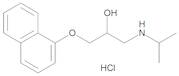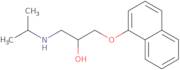
CAS 318-98-9
:Propranolol hydrochloride
- (.+-.)-Propranolol hydrochloride
- (R,S)-Propranolol hydrochloride
- (RS)-Propranolol hydrochloride
- 1-(1-Naphthoxy)-2-hydroxy-3-isopropylaminopropane hydrochloride
- 1-(1-Naphthyloxy)-2-hydroxy-3-isopropylaminopropane hydrochloride
- 1-(1-Naphthyloxy)-3-(isopropylamino)-2-propanol hydrochloride
- 1-(Isopropylamino)-3-(1-naphthoxy)-2-propanol hydrochloride
- 1-(Isopropylamino)-3-(1-naphthyloxy)propan-2-ol hydrochloride
- 1-(Isopropylamino)-3-(naphthalen-1-yloxy)propan-2-ol hydrochloride
- 1-(Naphthalen-1-yloxy)-3-[(propan-2-yl)amino]propan-2-ol hydrochloride
- 1-Isopropylamino-3-naphthalen-1-yloxypropan-2-ol monohydrochloride
- 1-[(1-Methylethyl)amino]-3-(1-naphthalenyloxy)-2-propanol hydrochloride
- 2-Propanol, 1-(isopropylamino)-3-(1-naphthyloxy)-, hydrochloride
- 2-Propanol, 1-[(1-methylethyl)amino]-3-(1-naphthalenyloxy)-, hydrochloride (1:1)
- <span class="text-smallcaps">D</smallcap><smallcap>L</span>-Anapriline
- <span class="text-smallcaps">D</smallcap><smallcap>L</span>-Propranolol hydrochloride
- Anaprilin
- Anapriline
- Angilol
- Apsolol
- Avlocardyl
- Bedranol
- Beprane
- Berkolol
- Beta-Neg
- Beta-Tablinen
- Beta-Timelets
- Betacap
- Cardinol
- Caridolol
- Chlorure De [2-Hydroxy-3-(Naphtyloxy)Propyl]Isopropylammonium
- Ciplar
- Cloruro De [2-Hidroxi-3-(Naftiloxi)Propil]Isopropilamonio
- DL-Anapriline
- Deralin
- Docitan
- Dociton
- Duranol
- Efektolol
- Elbol
- Frekven
- Hemangeol
- Hemangiol
- Ici 45520
- Inderal
- Inderal LA
- Inderalici
- Indobloc
- Intermigran
- Kemi S
- Monoprolol
- Naprilin
- Nsc 91523
- Obsidan
- Oposim
- Prano-Puren
- Prophylux
- Propranolol chloride
- Propranur
- Propraratiopharm
- Pylapron
- Rapynogen
- Sagittol
- Servanolol
- Sloprolol
- Sumial
- Tesnol
- [2-Hydroxy-3-(Naphthyloxy)Propyl]Isopropylammonium Chloride
- [2-Hydroxy-3-(naphthyloxy)propyl]isopropylammoniumchlorid
- dl-Propranolol hydrochloride
- See more synonyms
rac-Propranolol Hydrochloride
CAS:Controlled ProductApplications β−Adrenergic blocker. Antihypertensive; antianginal; antiarrhythmic (class II).
References Bond, et al.: Nature, 213, 721 (1967), Hansteen, V., et al.: Br. Med. J., 284, 155 (1982), Diamond, S., et al.: J. Clin. Pharmacol., 28, 193 (1988),Formula:C16H21NO2·ClHColor and Shape:NeatMolecular weight:295.8rac-Propranolol hydrochloride
CAS:Controlled ProductPropranolol is a beta-adrenergic receptor antagonist that is used to treat high blood pressure, chest pain and heart failure. It also has been shown to be effective in the treatment of inflammatory bowel disease (IBD). Propranolol blocks the binding of proprotein convertase subtilisin/kexin type 9 (PCSK9) to its receptors, which inhibits the production of LDL cholesterol. In humans, propranolol is metabolized through hydrolysis by esterases or glucuronidases, oxidation by cytochrome P450 enzymes, reduction by glutathione reductase, or conjugation with glucuronic acid. The drug also has a synergic effect with other drugs such as erythromycin and phenobarbital. Propranolol binds to proteins in red blood cells and decreases diastolic pressure.
Formula:C16H22ClNO2Purity:Min. 98%Color and Shape:White PowderMolecular weight:295.8 g/mol