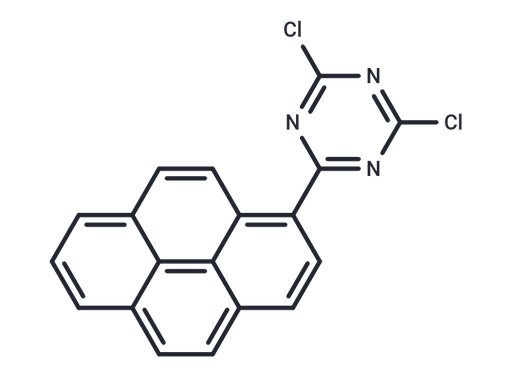
CAS 3224-36-0
:2,4-Dichloro-6-(1-pyrenyl)-1,3,5-triazine
Description:
2,4-Dichloro-6-(1-pyrenyl)-1,3,5-triazine is an organic compound characterized by its triazine ring structure, which is a six-membered aromatic heterocycle containing three nitrogen atoms. This compound features two chlorine substituents at the 2 and 4 positions and a pyrenyl group at the 6 position, contributing to its unique chemical properties. It is typically a solid at room temperature and may exhibit a range of colors depending on its purity and form. The presence of the pyrenyl group, a polycyclic aromatic hydrocarbon, imparts significant fluorescence properties, making it useful in various applications, including as a fluorescent probe in biochemical assays. Additionally, the chlorinated triazine structure can participate in nucleophilic substitution reactions, making it a versatile intermediate in organic synthesis. Its stability and reactivity can be influenced by environmental factors such as pH and temperature. Safety data indicates that, like many chlorinated compounds, it should be handled with care due to potential toxicity and environmental concerns.
Formula:C19H9Cl2N3
InChI:InChI=1S/C19H9Cl2N3/c20-18-22-17(23-19(21)24-18)14-9-7-12-5-4-10-2-1-3-11-6-8-13(14)16(12)15(10)11/h1-9H
InChI key:InChIKey=ZDMAOBNCIJTNCB-UHFFFAOYSA-N
SMILES:ClC1=NC(C2=C3C4=C5C(C=C3)=CC=CC5=CC=C4C=C2)=NC(Cl)=N1
Synonyms:- 2,4-Dichloro-6-(1-pyrenyl)-1,3,5-triazine
- 1-(4,6-Dichloro-1,3,5-triazin-2-yl)pyrene
- 2,4-Dichloro-6-pyren-1-yl-1,3,5-triazine
- 1,3,5-Triazine, 2,4-dichloro-6-(1-pyrenyl)-
- s-Triazine, 2,4-dichloro-6-(1-pyrenyl)-
Filter by
The purity filter is not visible because current products do not have associated purity data for filtering.
Found 2 products.
- Lower prices
- Higher prices
- Lower purities
- Higher purities
- Faster estimated delivery
1-(Dichloro-1,3,5-triazinyl)-pyrene
CAS:1-(Dichloro-1,3,5-triazinyl)-pyrene (1-(4,6-Dichloro-1,3,5-triazin-2-yl)pyrene) serves as a multifunctional dye with diverse applications in both traditional and emerging fields. In biological experiments, dyes facilitate the observation and analysis of cell structures, tracking of biomolecules, evaluation of cell functions, distinction of cell types, detection of biomolecules, examination of tissue pathology, and monitoring of microorganisms. Their utilization spans from foundational scientific research to extensive clinical diagnostics. Additionally, dyes are integral to the textile industry for coloring purposes, and find innovative uses in functional textile processing, food coloring, and dye-sensitized solar cells.Formula:C19H9Cl2N3Molecular weight:350.2