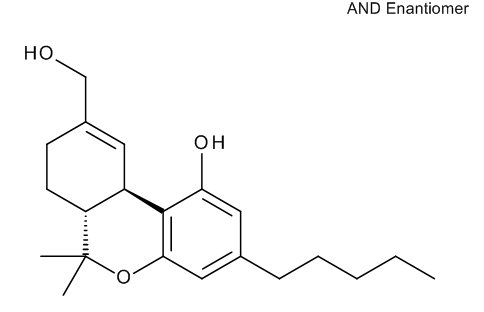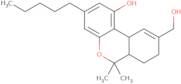
CAS 34675-49-5
:(+/-)-11-HYDROXY-DELTA9-THC
Description:
(+/-)-11-Hydroxy-delta-9-THC, with the CAS number 34675-49-5, is a psychoactive compound derived from tetrahydrocannabinol (THC), the primary active component of cannabis. This substance is a metabolite of delta-9-THC, formed in the liver after the consumption of cannabis. It exhibits similar psychoactive properties to delta-9-THC but is often considered to be more potent due to its higher affinity for cannabinoid receptors in the brain. The compound is characterized by its ability to bind to CB1 and CB2 receptors, influencing various physiological processes, including pain perception, mood, and appetite. Its solubility is primarily in organic solvents, and it has a relatively low molecular weight. The compound is of interest in both pharmacological research and therapeutic applications, particularly in the context of pain management and the treatment of certain medical conditions. However, its psychoactive effects necessitate careful consideration regarding dosage and administration.
Formula:C21H30O3
InChI:InChI=1S/C21H30O3/c1-4-5-6-7-14-11-18(23)20-16-10-15(13-22)8-9-17(16)21(2,3)24-19(20)12-14/h10-12,16-17,22-23H,4-9,13H2,1-3H3/t16-,17-/m1/s1
InChI key:YCBKSSAWEUDACY-IAGOWNOFSA-N
SMILES:CCCCCC1=CC(=C2[C@@H]3C=C(CC[C@H]3C(OC2=C1)(C)C)CO)O
Synonyms:- (±)-11-Hydroxy-Δ9-THC solution
- 6H-Dibenzo[b,d]pyran-9-methanol, 6a,7,8,10a-tetrahydro-1-hydroxy-6,6-dimethyl-3-pentyl-, (6aR,10aR)-rel-
- (±)-trans-11-OH-Δ9-THC
- (-11-hydroxy-9-THC (CRM)
- (6aR,10aR)-9-(hydroxymethyl)-6,6-dimethyl-3-pentyl-6a,7,8,10a-tetrahydrobenzo[c]chromen-1-ol
- raceMic Dronabinol Metabolite: (±)-11-Hydroxy-Δ9-tetrahydrocannabinol
- (±)-11-hydroxy-Δ9-THC
Filter by
Purity percentage
0
100
|
0
|
50
|
90
|
95
|
100
Found 5 products.
- Lower prices
- Higher prices
- Lower purities
- Higher purities
- Faster estimated delivery
trans-11-Hydroxy-δ9-THC ((6aRS,10aRS)-11-Hydroxy-δ9-tetrahydrocannabinol) 0.1 mg/ml in Methanol
CAS:Controlled ProductFormula:C21H30O3Color and Shape:ColourlessMolecular weight:330.46trans-11-Hydroxy-δ9-THC ((6aRS,10aRS)-11-Hydroxy-δ9-tetrahydrocannabinol) 1.0 mg/ml in Methanol
CAS:Controlled ProductFormula:C21H30O3Color and Shape:ColourlessMolecular weight:330.46d,l-11-Hydroxy-δ-9-THC, 0.1mg/ml in Methanol
CAS:Controlled ProductFormula:C21H30O3Color and Shape:ColourlessMolecular weight:330.46d,l-11-Hydroxy-δ-9-THC, 1mg/ml in Methanol
CAS:Controlled ProductFormula:C21H30O3Color and Shape:ColourlessMolecular weight:330.46(±)-11-Hydroxy-9-THC methanol solution (1 mg/ml)
CAS:Controlled Product11-Hydroxy-9-THC is a metabolite of THC that is found in human liver and urine. It is a potent agonist for the cannabinoid receptor. 11-Hydoxy-9-THC has been shown to inhibit protein synthesis by binding to the fatty acid binding site on the ribosomes. The effects of 11-hydroxy-9-THC may be due, in part, to the inhibition of endogenous substances such as anandamide or 2-AG, which are known to bind to these receptors. The metabolism of 11-hydroxy-9 THC by liver enzymes and other enzymes has not been studied.Formula:C21H30O3Purity:Min. 98 Area-%Color and Shape:PowderMolecular weight:330.46 g/mol