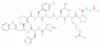
CAS 35263-73-1
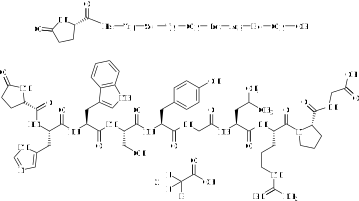
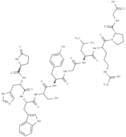
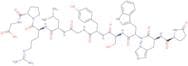
:(gly-oh10)-luteinizing hormone*releasing hormone
Description:
Glycyl-Luteinizing Hormone-Releasing Hormone (often abbreviated as Gly-LHRH) is a synthetic peptide that plays a crucial role in the regulation of reproductive hormones. It is a decapeptide, meaning it consists of ten amino acids, and is a derivative of the naturally occurring Luteinizing Hormone-Releasing Hormone (LHRH). The primary function of Gly-LHRH is to stimulate the release of luteinizing hormone (LH) and follicle-stimulating hormone (FSH) from the anterior pituitary gland, which are essential for reproductive processes in both males and females. The modification of the peptide structure, such as the addition of a glycine residue, can enhance its stability and bioactivity compared to its natural counterpart. Gly-LHRH is utilized in various biomedical applications, including research on reproductive health and potential therapeutic interventions for hormone-related disorders. Its CAS number, 35263-73-1, is a unique identifier that facilitates the cataloging and identification of this specific chemical substance in scientific literature and databases.
Formula:C55H74N16O14
InChI:InChI=1/C55H74N16O14/c1-29(2)19-38(49(80)66-37(9-5-17-59-55(56)57)54(85)71-18-6-10-43(71)53(84)62-26-46(76)77)65-45(75)25-61-47(78)39(20-30-11-13-33(73)14-12-30)67-52(83)42(27-72)70-50(81)40(21-31-23-60-35-8-4-3-7-34(31)35)68-51(82)41(22-32-24-58-28-63-32)69-48(79)36-15-16-44(74)64-36/h3-4,7-8,11-14,23-24,28-29,36-43,60,72-73H,5-6,9-10,15-22,25-27H2,1-2H3,(H,58,63)(H,61,78)(H,62,84)(H,64,74)(H,65,75)(H,66,80)(H,67,83)(H,68,82)(H,69,79)(H,70,81)(H,76,77)(H4,56,57,59)/t36-,37-,38-,39-,40-,41-,42-,43-/m0/s1
SMILES:CC(C)C[C@@H](C(=N[C@@H](CCCNC(=N)N)C(=O)N1CCC[C@H]1C(=NCC(=O)O)O)O)N=C(CN=C([C@H](Cc1ccc(cc1)O)N=C([C@H](CO)N=C([C@H](Cc1c[nH]c2ccccc12)N=C([C@H](Cc1cnc[nH]1)N=C([C@@H]1CCC(=N1)O)O)O)O)O)O)O
Synonyms:- LHRH (free acid)
- Pyr-His-Trp-Ser-Tyr-Gly-Leu-Arg-Pro-Gly-OH
- 5-oxo-L-prolyl-L-histidyl-L-tryptophyl-L-seryl-L-tyrosylglycyl-L-leucyl-N~5~-(diaminomethylidene)-L-ornithyl-L-prolylglycine
- PYR-HWSYGLRPG
- LHRH, Gly(10)-
- gly(10)-lhr
- LUTEINIZING HORMONE-RELEASING HORMONE
- [PYR]HWSYGLRPG-OH
- ((S)-5-Oxopyrrolidine-2-carbonyl)-L-histidyl-L-tryptophyl-L-seryl-L-tyrosylglycyl-L-leucyl-L-arginyl-L-prolylglycine
- LH-RH (FREE ACID)
- LHRH
- LUTEINIZING HORMONE-RELEASING HORMONE (FREE ACID)
- LH-RH(OH)
- PYROGLU-HIS-TRP-SER-TYR-GLY-LEU-ARG-PRO-GLY
- [GLY-OH10]-LH-RH
- (gly-oh10)-luteinizing hormone*releasing hormone
- LUTEINIZING HORMONE-RELEASING HORMONE (LH-RH), HUMAN
- GnRH (free acid), Gonadorelin (free acid)
- PYR-HIS-TRP-SER-TYR-GLY-LEU-ARG-PRO-GLY
- GONADOTROPIN-RELEASING HORMONE
- [Gly-OH10]-LH-RH, LH-RH, pGlu-His-Trp-Ser-Tyr-Gly-Leu-Arg-Pro-Gly
- LHRH USP/EP/BP
- GLP-HIS-TRP-SER-TYR-GLY-LEU-ARG-PRO-GLY
- See more synonyms
Sort by
Purity (%)
0
100
|
0
|
50
|
90
|
95
|
100
Found 6 products.
Gonadorelin Acetate Related Compound A (5-Oxo-L-prolyl-L-histidyl-L-tryptophyl-L-seryl-L-tyrosylglycyl-L-leucyl-L-arginyl-L-prolylglycine)
CAS:Polypeptide, protein and glycoprotein hormones, their derivatives and structural analogues, nesoiFormula:C55H74N16O14Color and Shape:White PowderMolecular weight:1182.55704Gonadorelin Acetate USP Related Compound A Ditrifluoroacetate
CAS:Formula:C55H74N16O14·2C2HF3O2Molecular weight:1183.30 2*114.02LHRH
CAS:Luteinizing hormone-releasing hormone (LHRH) is a neuropeptide produced in the hypothalamus that plays a pivotal role in regulating reproduction and hasFormula:C55H74N16O14Purity:98%Color and Shape:SolidMolecular weight:1183.27((S)-5-Oxopyrrolidine-2-carbonyl)-L-histidyl-L-tryptophyl-L-seryl-L-tyrosylglycyl-L-leucyl-L-arginyl-L-prolylglycine
CAS:Formula:C55H74N16O14Molecular weight:1183.3LHRH (free acid) trifluoroacetate salt
CAS:LHRH (free acid) trifluoroacetate salt Pyr-His-Trp-Ser-Tyr-Gly-Leu-Arg-Pro-Gly-OH trifluoroacetate salt is a decapeptide that is the most potent form of the hormone luteinizing hormone releasing hormone (LHRH). It has been shown to bind to surface receptors and activate a G protein, which activates adenyl cyclase. This leads to increased levels of cyclic adenosine monophosphate (cAMP) in cells. LHRH also binds to blood vessels and causes vasodilation. LHRH also binds to pyroglutamic acid, which is an amino acid found in peptides that have affinity for peptidases. This binding causes the release of peptidases from the cell membrane, uncovers receptor sites, and increases cAMP production. LHRH has also been shown to inhibit kidney functionFormula:C55H74N16O14Purity:Min. 95%Molecular weight:1,183.28 g/molLHRH (free acid)
CAS:Bachem ID: 4009735.
Formula:C55H74N16O14Purity:98.5%Color and Shape:WhiteMolecular weight:1183.29