CAS 39562-70-4
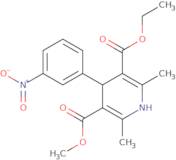
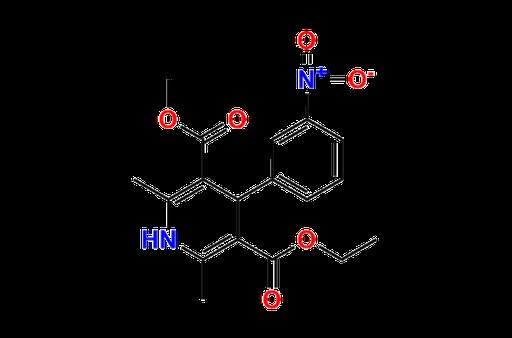
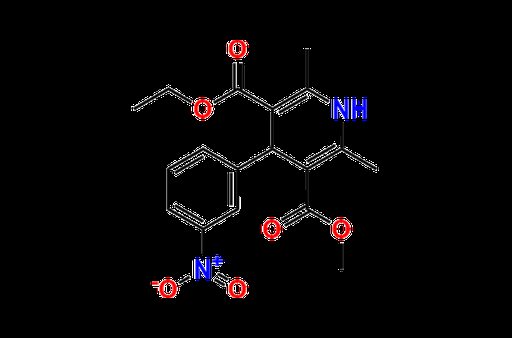
:Nitrendipine
Description:
Nitrendipine is a calcium channel blocker primarily used in the treatment of hypertension and angina pectoris. It belongs to the dihydropyridine class of compounds, which are characterized by their ability to selectively inhibit calcium influx through L-type calcium channels in vascular smooth muscle and cardiac tissue. This action leads to vasodilation and a subsequent decrease in blood pressure. Nitrendipine is known for its high lipophilicity, which enhances its absorption and distribution in the body. The compound typically exhibits a long half-life, allowing for once-daily dosing in clinical settings. Its chemical structure includes a nitro group, which contributes to its pharmacological properties. Nitrendipine is generally well-tolerated, but like other calcium channel blockers, it may cause side effects such as headache, flushing, or peripheral edema. As with any medication, it is important to consider contraindications and potential interactions with other drugs. Overall, nitrendipine is an effective agent in managing cardiovascular conditions, contributing to improved patient outcomes.
Formula:C18H20N2O6
InChI:InChI=1/C18H20N2O6/c1-5-26-18(22)15-11(3)19-10(2)14(17(21)25-4)16(15)12-7-6-8-13(9-12)20(23)24/h6-9,15-16H,5H2,1-4H3/t15?,16-/m1/s1
InChI key:InChIKey=PVHUJELLJLJGLN-UHFFFAOYSA-N
SMILES:C(OCC)(=O)C=1C(C(C(OC)=O)=C(C)NC1C)C2=CC(N(=O)=O)=CC=C2
Synonyms:- (.+-.)-Bay E 5009
- (.+-.)-Nitrendipine
- 3,5-Pyridinedicarboxylic acid, 1,4-dihydro-2,6-dimethyl-4-(3-nitrophenyl)-, 3-ethyl 5-methyl ester
- Baylotensin
- Bayotensin
- Baypress
- Bylotensin
- Cardif
- Deiten
- Nidrel
- Nitrendipin
- Nitrendipino
- Nitrepin
- 3,5-Pyridinedicarboxylic acid, 1,4-dihydro-2,6-dimethyl-4-(3-nitrophenyl)-, ethyl methyl ester
- 3-ethyl 5-methyl (4S)-2,6-dimethyl-4-(3-nitrophenyl)-3,4-dihydropyridine-3,5-dicarboxylate
- 1,4-dihydro-2,6-dimethyl-4-(3-nitrophenyl)-3,5-pyridinedicarboxylic acid ethyl methyl ester
- 3-ethyl 5-methyl (4R)-2,6-dimethyl-4-(3-nitrophenyl)-3,4-dihydropyridine-3,5-dicarboxylate
- ethyl methyl 1,4-dihydro-2,6-dimethyl-4-(meta-nitrophenyl)-3,5-pyridinedicarboxylate
- NITRENDIPINE IMPURITY AETHYL METHYL-2,6-DIMETHYL-4-(3-NITROPHENYL) PYRIDINE-3,5-DICARBOXYLATE
- ylmethylester
- NITRENDIPINE EPN(CRM STANDARD)
- (NITROPHENYLPYRIDINE ANALOGUE) EPN(CRM STANDARD)
- 3,5-Pyridinedicarboxylic acid, 1,4-dihydro-2,6-dimethyl-4-(3-nitrophenyl)-, ethyl methyl ester (9CI)
- NITRENDIPINE >95% CA2+ CHANNEL BLOCKER,
- ethylmethyl1,4-dihydro-2,6-dimethyl-4-(m-nitrophenyl)-3,5-pyridinedicarboxy
- 1,4-dihydro-2,6-dimethyl-4-(3-nitrophenyl)-3,5-pyridinedicarboxylicacidethy
- NITRENDIPINE MM(CRM STANDARD)
- baye5009
- See more synonyms
Sort by
Purity (%)
0
100
|
0
|
50
|
90
|
95
|
100
(RS)-Methyl ethyl 1,4-dihydro-2,6-dimethyl-4-(3-nitrophenyl)pyridine-3,5-dicarboxylate - EP Grade
CAS:Propranolol hydrochloride is a non-selective beta-adrenergic blocker that blocks the effects of epinephrine, norepinephrine and dopamine. Propranolol hydrochloride has been shown to inhibit the activity of proximal tubules in the kidney, which may be due to its inhibition of chemical ionization. This drug also has antihypertensive activity and can be used for the treatment of cardiac disorders such as hypertension. Propranolol hydrochloride is a monoclonal antibody that is activated by nitro groups and binds with high affinity to multiple-reaction monitoring (MRM) transitions for protonated molecular ions at m/z 289, 296, 305, 313, 320, 328, 336 and 344. Propranolol hydrochloride also has vasodilatory effects on the papillary muscle which aids in regulating blood pressure by maintaining vascular resistance.Formula:C18H20N2O6Purity:Min. 95%Molecular weight:360.36 g/mol