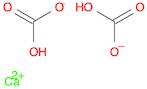
CAS 3983-19-5
:Calcium bicarbonate
Description:
Calcium bicarbonate, with the CAS number 3983-19-5, is an inorganic compound that is commonly encountered in aqueous solutions rather than as a solid. It is formed when calcium carbonate reacts with carbon dioxide in the presence of water, leading to its dissolution in water. This compound is characterized by its relatively low solubility in water, which increases with rising carbon dioxide levels. Calcium bicarbonate plays a significant role in natural water systems, contributing to the hardness of water and influencing the carbonate equilibrium in aquatic environments. It is also involved in geological processes, such as the formation of limestone and other sedimentary rocks. In terms of its chemical structure, it consists of one calcium ion (Ca²⁺) and two bicarbonate ions (HCO₃⁻), making it a source of both calcium and bicarbonate in solution. While it is not typically used in industrial applications, it is important in biological systems and environmental chemistry, particularly in the context of water quality and carbonate chemistry.
Formula:CH2O3Ca
InChI:InChI=1S/CH2O3.Ca/c2-1(3)4;/h(H2,2,3,4);
InChI key:InChIKey=FYHXNYLLNIKZMR-UHFFFAOYSA-N
SMILES:C(=O)(O)O.[Ca]
Synonyms:- Calcium bicarbonate
- Calcium carbonate (Ca(HCO<sub>3</sub>)<sub>2</sub>)
- Calcium hydrogen carbonate
- Calcium hydrogen carbonate (Ca(HCO<sub>3</sub>)<sub>2</sub>)
- Carbonic acid, calcium salt (2:1)
- Calcium hydrogen carbonate (Ca(HCO3)2)
- Calcium carbonate (Ca(HCO3)2)
Filter by
Purity percentage
0
100
|
0
|
50
|
90
|
95
|
100
Found 2 products.
- Lower prices
- Higher prices
- Lower purities
- Higher purities
- Faster estimated delivery