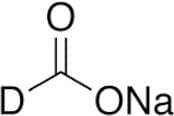
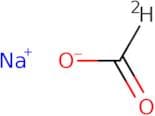
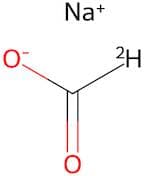
CAS 3996-15-4
:sodium formate-D
Description:
Sodium formate-D, with the CAS number 3996-15-4, is the deuterated form of sodium formate, a sodium salt of formic acid. It is characterized by the presence of deuterium, a stable isotope of hydrogen, which replaces the hydrogen atoms in the formate ion. This substitution makes sodium formate-D particularly useful in various scientific applications, including nuclear magnetic resonance (NMR) spectroscopy, where it serves as a solvent or reference standard due to its unique spectral properties. Sodium formate-D is typically a white, crystalline solid that is soluble in water, exhibiting similar solubility characteristics to its non-deuterated counterpart. Its chemical formula is C2H3DNaO2, and it retains the properties of formate salts, such as acting as a buffering agent and participating in various chemical reactions. The presence of deuterium can also influence reaction kinetics and mechanisms, making it valuable in studies of reaction pathways and dynamics. Overall, sodium formate-D is a versatile compound in both analytical and synthetic chemistry.
Sort by
Purity (%)
0
100
|
0
|
50
|
90
|
95
|
100
Found 6 products.
Sodium Formate-d1
CAS:Formula:DCOONaPurity:99 atom % DColor and Shape:White SolidMolecular weight:68.9937Sodium formate-D >99.5 Atom % D 1 pack = 10g bottle
CAS:Sodium formate-D >99.5 Atom % D 1 pack = 10g bottle
Formula:·Na·HCO2Purity:>99.5 Atom % DColor and Shape: white to greyish powderMolecular weight:68.01g/molSodium Formate-d
CAS:Controlled ProductApplications Labelled Sodium Formate is used in various organic reactions and syntheses. It is used in the preparation of [3,2b]pyridines as well as the palladium-catalyzed coupling of vinyl triflates with organostannanes.
References Mathes, B. et al.: Tetra., 44, 725 (2003); Scott, W. et al.: J. Am. Chem. Soc., 108, 3033 (1986);Formula:C2HO2·NaColor and Shape:NeatMolecular weight:69.01Sodium formate-d
CAS:Controlled ProductSodium formate-d is a monosodium salt that is used to introduce bioactive molecules into cells and tissues. This method is efficient and can be performed in a constant manner. Sodium formate-d can be introduced into cells and tissues by adding hydrochloric acid, which facilitates the hydrolysis of the ester linkage of the molecule to produce monosodium formate (MSF) and sodium chloride. The kinetics of this reaction can be determined in a kinetic manner. Buffers are also required for this reaction to maintain pH levels, as well as polarizability to maintain solubility of the reactants. Deuterated MSF has been shown to have oriented alkylation with deuterated DNA, which provides insight into its mechanism.Formula:CDNaO2Purity:Min. 95%Color and Shape:PowderMolecular weight:69.01 g/mol