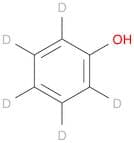
CAS 4165-62-2
:Phen-d5-ol
Description:
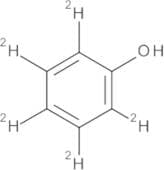
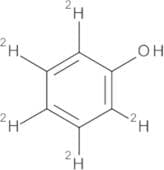
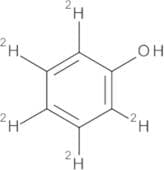
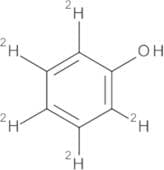
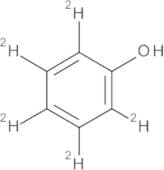
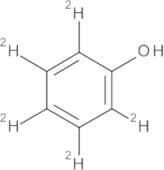
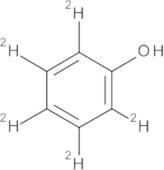
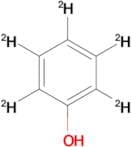
Phen-d5-ol, also known as 1,1,2,2,3,3-hexadeuterophenol, is a deuterated form of phenol, where five hydrogen atoms are replaced by deuterium isotopes. This compound is characterized by its aromatic structure, featuring a hydroxyl (-OH) group attached to a benzene ring. The presence of deuterium enhances its stability and alters its physical properties compared to non-deuterated phenol, making it useful in various applications, particularly in NMR spectroscopy, where it serves as a valuable internal standard due to its distinct spectral characteristics. Phen-d5-ol is typically a colorless to pale yellow liquid or solid, depending on temperature, and exhibits typical phenolic properties, such as being soluble in organic solvents and having moderate solubility in water. Its chemical behavior is similar to that of regular phenol, including its ability to undergo electrophilic substitution reactions. Safety precautions should be taken when handling this compound, as it can be harmful if ingested or inhaled, and appropriate protective equipment should be used.
Formula:C6HD5O
InChI:InChI=1S/C6H6O/c7-6-4-2-1-3-5-6/h1-5,7H/i1D,2D,3D,4D,5D
InChI key:InChIKey=ISWSIDIOOBJBQZ-RALIUCGRSA-N
SMILES:OC1=C(C(=C(C(=C1[2H])[2H])[2H])[2H])[2H]
Synonyms:- 2,3,4,5,6-Pentadeuteriophenol
- Pentadeuteriophenol
- Phen-2,3,4,5,6-d<sub>5</sub>-ol
- Phen-d5-ol
- Phen-d<sub>5</sub>-ol
- Phenol-d5
- Phen-2,3,4,5,6-d5-ol
Sort by
Purity (%)
0
100
|
0
|
50
|
90
|
95
|
100
Found 17 products.
Phenol-2,3,4,5,6-d5
CAS:Formula:C6D5OHPurity:98 atom % DColor and Shape:White Pink CrystalsMolecular weight:99.07325Phenol D5 200 µg/mL in Dichloromethane
CAS:Controlled ProductFormula:C6D5HOColor and Shape:Single SolutionMolecular weight:99.14Phenol D5 (2,3,4,5,6 D5)
CAS:Controlled ProductFormula:C6D5HOColor and Shape:NeatMolecular weight:99.14Phenol D5 (2,3,4,5,6 D5) 100 µg/mL in Acetone
CAS:Controlled ProductFormula:C6D5HOColor and Shape:Single SolutionMolecular weight:99.14EPA Method 8270 BNA Surrogate Mixture 5000 µg/mL in Dichloromethane
CAS:Controlled ProductFormula:C6H3Br3OColor and Shape:MixtureMolecular weight:330.80EPA Method 8270 Acid Surrogate Mixture 2000 µg/mL in Methanol
CAS:Controlled ProductFormula:C6H3Br3OColor and Shape:MixtureMolecular weight:330.80EPA Method 8270 BNA Surrogate Mixture 594 1000 µg/mL in Acetone
CAS:Controlled ProductColor and Shape:MixtureSurrogate Standard Acid Mix 18 2000 µg/mL in Methanol
CAS:Controlled ProductFormula:C6H3Br3OColor and Shape:MixtureMolecular weight:330.80Phenol D5 (2,3,4,5,6 D5) 100 µg/mL in Methanol
CAS:Controlled ProductFormula:C6D5HOColor and Shape:Single SolutionMolecular weight:99.14EPA Method 8270 BNA Surrogate Mixture 599 200-400 µg/mL in Dichloromethane
CAS:Controlled ProductColor and Shape:MixtureSurrogate Standard Mixture 915 4000 µg/mL in Dichloromethane
CAS:Controlled ProductFormula:C6H3Br3OColor and Shape:MixtureMolecular weight:330.80BNA Surrogate Standards Mixture 1000-1500 µg/mL in Methanol/Dichloromethane
CAS:Controlled ProductColor and Shape:ColourlessPhenol D5
CAS:Controlled ProductApplications Phenol is purified here for molecular genetics applications. It is naturally found in tea leaves and plants, and has uses in the synthesis of antioxidant compounds due to the antioxidant activity caused by the phenol moiety. This structure also allows it to be used for syntheses of anti-bacterial & anti-carcinogenic compounds. This is the labelled analog.
Not a dangerous good if item is equal to or less than 1g/ml and there is less than 100g/ml in the package
References Nam, S. et al.: J. Agri. Chem., 60, 9097 (2012); Xia, J. et al.: J. Agri. Chem., 57, 99 (2009); Khanal, P. et al.: Carcinogenesis, 32, 545 (2011);Formula:C6D5HOColor and Shape:NeatMolecular weight:99.14EPA Method 625.1 Surrogate Mixture 1000 µg/mL in Methanol
CAS:Controlled ProductFormula:C6H5FOColor and Shape:MixtureMolecular weight:112.10