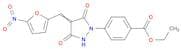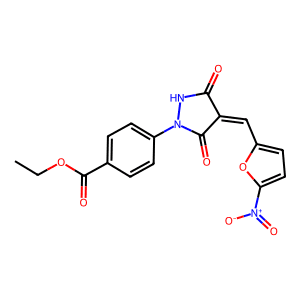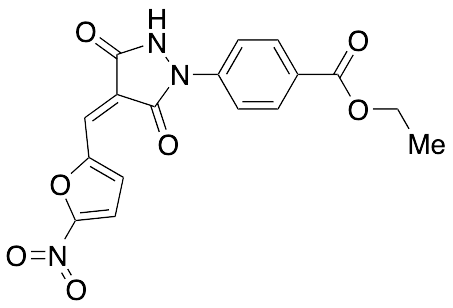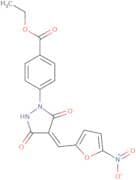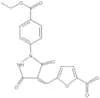
CAS 418805-02-4
:PYR-41
Description:
PYR-41, identified by its CAS number 418805-02-4, is a chemical compound that belongs to the class of pyrimidine derivatives. It is primarily recognized for its role as a selective inhibitor of certain protein kinases, which makes it of interest in pharmaceutical research, particularly in the context of cancer treatment and other diseases where kinase activity is dysregulated. The compound exhibits specific binding affinity to its target enzymes, influencing various cellular signaling pathways. In terms of physical properties, PYR-41 is typically characterized by its molecular structure, which includes a pyrimidine ring, and may possess functional groups that enhance its solubility and bioavailability. Its efficacy and safety profile are subjects of ongoing studies, as researchers explore its potential therapeutic applications. As with many chemical substances, handling and usage require adherence to safety protocols to mitigate any associated risks.
Formula:C17H13N3O7
InChI:InChI=1S/C17H13N3O7/c1-2-26-17(23)10-3-5-11(6-4-10)19-16(22)13(15(21)18-19)9-12-7-8-14(27-12)20(24)25/h3-9H,2H2,1H3,(H,18,21)
InChI key:InChIKey=ARGIPZKQJGFSGQ-UHFFFAOYSA-N
SMILES:O=C1N(NC(=O)C1=CC=2OC(N(=O)=O)=CC2)C3=CC=C(C(OCC)=O)C=C3
Sort by
Purity (%)
0
100
|
0
|
50
|
90
|
95
|
100
Found 5 products.
PYR-41
CAS:PYR-41 is the first cell-permeable inhibitor of ubiquitin-activating enzyme E1, with no activity at E2.Formula:C17H13N3O7Purity:98.25%Color and Shape:SolidMolecular weight:371.3Ref: TM-T6629
2mg37.00€5mg54.00€10mg82.00€25mg154.00€50mg294.00€100mg447.00€200mg618.00€500mg973.00€1mL*10mM (DMSO)60.00€PYR-41
CAS:Applications PYR-41 is the cell-permeable inhibitor of ubiquitin-activating enzyme E1, with no activity at E2.
References Yang, Y., et al.; Cancer Res., 67, 9472 (2007); Ungermannova, D., et al.: J. Biomol. Screening, 17, 421 (2012)Formula:C17H13N3O7Color and Shape:Dark Red SolidMolecular weight:371.3PYR 41
CAS:PYR-41 is a small molecule inhibitor, which is sourced from chemical synthesis. It functions primarily by targeting ubiquitin-activating enzymes, particularly the E1 enzyme, to disrupt the ubiquitination process. This mechanism effectively hampers the transfer of ubiquitin to substrate proteins, thereby modulating protein degradation and signaling pathways.Formula:C17H13N3O7Purity:Min. 95%Molecular weight:371.3 g/mol