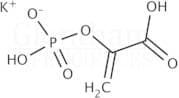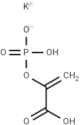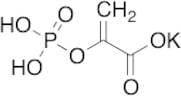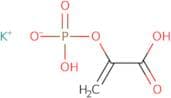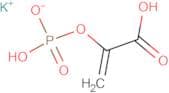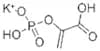
CAS 4265-07-0
:Monopotassium phosphoenolpyruvate
Description:
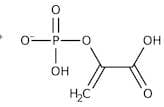
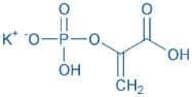
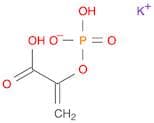
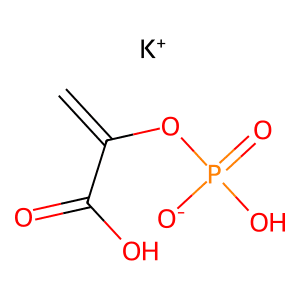
Monopotassium phosphoenolpyruvate (CAS 4265-07-0) is a chemical compound that serves as an important intermediate in various biochemical pathways, particularly in the metabolism of carbohydrates and amino acids. It is the potassium salt of phosphoenolpyruvic acid, characterized by its high-energy phosphate bond, which plays a crucial role in energy transfer within cells. This compound is typically found in a crystalline form and is soluble in water, making it readily available for biological reactions. Monopotassium phosphoenolpyruvate is involved in the catalysis of several enzymatic reactions, including those mediated by pyruvate kinase, and is significant in the context of glycolysis and gluconeogenesis. Its structure features a phosphoenol group, which contributes to its reactivity and energy-rich nature. Additionally, it is utilized in various biochemical assays and research applications, particularly in studies related to metabolic pathways and enzyme kinetics. Overall, monopotassium phosphoenolpyruvate is a vital compound in biochemistry, reflecting its importance in cellular metabolism and energy production.
Formula:C3H5O6P·K
InChI:InChI=1S/C3H5O6P.K/c1-2(3(4)5)9-10(6,7)8;/h1H2,(H,4,5)(H2,6,7,8);
InChI key:InChIKey=RJPINWGLSYHRIW-UHFFFAOYSA-N
SMILES:C(OP(=O)(O)O)(C(O)=O)=C.[K]
Synonyms:- 2-Propenoic acid, 2-(phosphonooxy)-, monopotassium salt
- 2-Propenoic acid, 2-(phosphonooxy)-, potassium salt (1:1)
- Acrylic acid, 2-hydroxy-, dihydrogen phosphate, monopotassium salt
- Phosphoenol pyruvate monopotassium salt
- Phosphoenolpyruvate potassium salt
- Phosphoenolpyruvic Acid Monopotassium Salt
- Phosphoenolpyruvic acid potassium salt
- Potassium 1-Carboxyethenyl Hydrogen Phosphate
- Monopotassium phosphoenolpyruvate
Sort by
Purity (%)
0
100
|
0
|
50
|
90
|
95
|
100
Found 14 products.
Phosphoenolpyruvic acid monopotassium salt, 99%
CAS:Phosphoenolpyruvic acid monopotassium salt is used in glycolysis and gluconeogeneis. It is used for regeneration of ATP from ADP in enzyme-catalyzed syntheses. It is metabolized by an enzyme namely pyruvate kinase to yield pyruvate. It acts as protection against cell injury induced by oxidative streFormula:C3H4KO6PPurity:99%Color and Shape:White, powderMolecular weight:206.13Phosphoenolpyruvate potassium salt
CAS:Substrate for many kinases such as pyruvate kinase and phosphoenolpyruvate carboxykinase.Formula:C3H4KO6PPurity:> 98%Color and Shape:White PowderMolecular weight:206.13Potassium 1-carboxyvinyl hydrogenphosphate
CAS:Formula:C3H5KO6PPurity:97%Color and Shape:SolidMolecular weight:207.1403Phosphoenolpyruvic acid, monopotassium salt
CAS:Phosphoenolpyruvic acid, monopotassium saltFormula:C3H4O6P·KPurity:97%Color and Shape:White Solid-PowderMolecular weight:206.13232Phosphoenol pyruvate monopotassium salt
CAS:Formula:C3H4KO6PPurity:(HPLC) ≥ 98.0%Color and Shape:White to off-white powder or crystalsMolecular weight:206.14Potassium 1-carboxyvinyl hydrogenphosphate
CAS:Potassium 1-carboxyvinyl hydrogenphosphateFormula:C3H4KO6PPurity:≥98%Molecular weight:206.13Phosphoenolpyruvic Acid,Monopotassium Salt(unlabelled)
CAS:Formula:KOP(O)(OH)OCCH2)COOHColor and Shape:White SolidMolecular weight:206.12Potassium 1-carboxyvinyl hydrogenphosphate
CAS:Potassium 1-carboxyvinyl hydrogenphosphate (PEP-K) is involved in glycolysis and gluconeogeneis. PEP is metabolized by Pyruvate Kinase to yield pyruvate.Formula:C3H4KO6PPurity:99.44% - >99.99%Color and Shape:White To Light Yellow Fine Crystalline PowderMolecular weight:206.13Phospho(enol)pyruvic Acid Monopotassium Salt
CAS:Controlled ProductApplications Phospho(enol)pyruvic Acid Monopotassium Salt is a reactant used in the preparation of substrate analogs of creatine kinase with anticancer activity.
References Bergnes, G., et. al.: Oncol. Res., 8, 121 (1996);Formula:C3H4O6P·KColor and Shape:NeatMolecular weight:206.13Phosphoenolpyruvate potassium salt
CAS:Emax (230 nm) = 3113
Formula:C3H4O6PKColor and Shape:White PowderMolecular weight:206.13 g/molPhosphoenolpyruvate, monopotassium salt
CAS:M02738 - Phosphoenolpyruvate, monopotassium salt
Formula:C3H4KO6PPurity:96%Color and Shape:Solid, PowderMolecular weight:206.131