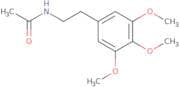
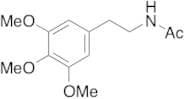
![N-[2-(3,4,5-Trimethoxyphenyl)ethyl]acetamide](/_next/image/?url=https%3A%2Fstatic.cymitquimica.com%2Fcas-image%2Fthumb-webp%2F373134-n-2-345-trimethoxyphenyl-ethyl-acetamide.webp&w=3840&q=75)
CAS 4593-89-9
:N-[2-(3,4,5-Trimethoxyphenyl)ethyl]acetamide
Description:
N-[2-(3,4,5-Trimethoxyphenyl)ethyl]acetamide, with the CAS number 4593-89-9, is an organic compound characterized by its amide functional group and a substituted phenyl ring. The presence of three methoxy groups on the phenyl ring enhances its lipophilicity and may influence its biological activity. This compound typically appears as a white to off-white solid and is soluble in organic solvents, reflecting its hydrophobic nature. Its molecular structure suggests potential applications in medicinal chemistry, particularly in the development of pharmaceuticals, due to the presence of the acetamide moiety, which is often associated with various biological activities. Additionally, the trimethoxyphenyl group may contribute to interactions with biological targets, making it of interest in research related to drug design and synthesis. As with many organic compounds, handling should be done with care, considering safety data and potential toxicity. Overall, N-[2-(3,4,5-Trimethoxyphenyl)ethyl]acetamide represents a compound of interest in both synthetic and medicinal chemistry contexts.
Formula:C13H19NO4
InChI:InChI=1S/C13H19NO4/c1-9(15)14-6-5-10-7-11(16-2)13(18-4)12(8-10)17-3/h7-8H,5-6H2,1-4H3,(H,14,15)
InChI key:InChIKey=SNMFNOQKGANWHD-UHFFFAOYSA-N
SMILES:O(C)C1=C(OC)C=C(CCNC(C)=O)C=C1OC
Synonyms:- Mescaline, N-acetyl-
- Acetamide, N-[2-(3,4,5-trimethoxyphenyl)ethyl]-
- N-Acetylmescaline
- N-[2-(3,4,5-Trimethoxyphenyl)ethyl]acetamide
- Acetamide, N-(3,4,5-trimethoxyphenethyl)-
Sort by
Purity (%)
0
100
|
0
|
50
|
90
|
95
|
100
Found 2 products.
N-Acetyl mescaline
CAS:Controlled ProductN-Acetyl mescaline is a synthetic compound derived from the naturally occurring hallucinogen mescaline, which is sourced from the Peyote cactus (Lophophora williamsii) and other cacti. As an N-acetylated derivative, its chemical modification impacts the compound's mode of action, particularly in its interaction with serotonin (5-HT) receptors.This acetylation can alter the pharmacokinetics, potentially influencing its binding affinity and efficacy at various receptor sites, such as 5-HT2A. This receptor is notably implicated in the mechanism of action of classic psychedelics, mediating their sensory and cognitive effects.While mescaline is known for its strong psychotropic effects, N-Acetyl mescaline presents a modified profile, which may alter its psychoactive properties and duration of action. This compound is primarily studied in research settings to investigate its unique interactions with the neural network and its potential implications for neuroscience.Formula:C13H19NO4Purity:Min. 98 Area-%Color and Shape:PowderMolecular weight:253.29 g/molN-Acetyl Mescaline
CAS:Controlled ProductApplications A metabolite of Mescaline (T795730).
References Musacchio, J.M. et al.: Biochem. Pharmacol., 16, 963 (1967), Andreu, J., et al.: Biochemistry, 30, 3777 (1991), Banerjee, A., et al.: J. Biol. Chem., 267, 13335 (1992),Formula:C13H19NO4Color and Shape:NeatMolecular weight:253.29