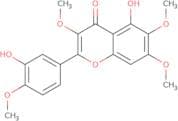
CAS 479-91-4
:Casticin
Description:
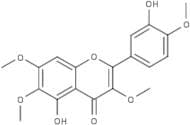
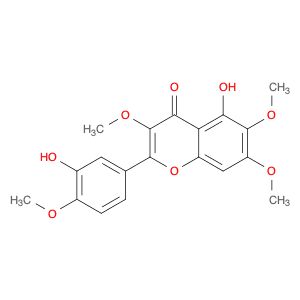
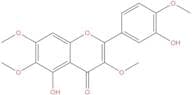
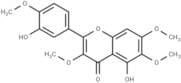
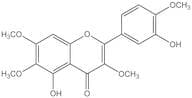
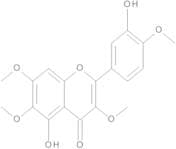
Casticin, with the CAS number 479-91-4, is a flavonoid compound primarily found in various plants, particularly in the genus Vitex, such as Vitex agnus-castus (chaste tree). It is characterized by its yellow crystalline appearance and is known for its potential pharmacological properties, including anti-inflammatory, antioxidant, and neuroprotective effects. Casticin exhibits a range of biological activities, which have garnered interest in the fields of herbal medicine and pharmacology. Its mechanism of action may involve modulation of various signaling pathways and interactions with specific receptors. Additionally, casticin has been studied for its potential effects on hormonal regulation, particularly in relation to reproductive health. The compound is soluble in organic solvents but has limited solubility in water, which is a common characteristic of many flavonoids. Overall, casticin represents a significant area of research due to its diverse biological activities and potential therapeutic applications.
Formula:C19H18O8
InChI:InChI=1S/C19H18O8/c1-23-11-6-5-9(7-10(11)20)17-19(26-4)16(22)14-12(27-17)8-13(24-2)18(25-3)15(14)21/h5-8,20-21H,1-4H3
InChI key:InChIKey=PJQLSMYMOKWUJG-UHFFFAOYSA-N
SMILES:O=C1C=2C(OC(=C1OC)C3=CC(O)=C(OC)C=C3)=CC(OC)=C(OC)C2O
Synonyms:- 3,6,7,4′-Tetra-O-methyl-5,3′-dihydroxyflavone
- 3,6,7,4′-Tetra-O-methylquercetagetin
- 4H-1-benzopyran-4-one, 5-hydroxy-2-(3-hydroxy-4-methoxyphenyl)-3,6,7-trimethoxy-
- 5,12-Dihydroxy-2,6,7,13-tetramethoxyflavone
- 5,3′-Dihydroxy-3,6,7,4′-tetramethoxyflavone
- 5-Hydroxy-2-(3-hydroxy-4-methoxyphenyl)-3,6,7-trimethoxy-4H-1-benzopyran-4-one
- 5-Hydroxy-2-(3-hydroxy-4-methoxyphenyl)-3,6,7-trimethoxy-4H-chromen-4-on
- 5-Hydroxy-2-(3-hydroxy-4-methoxyphenyl)-3,6,7-trimethoxy-4H-chromen-4-one
- Casticine
- Flavone, 3′,5-dihydroxy-3,4′,6,7-tetramethoxy-
- Quercetagetin 3,6,7,4′-tetramethyl ether
- Vitexcarpin
- Vitexicarpin
- See more synonyms
Sort by
Purity (%)
0
100
|
0
|
50
|
90
|
95
|
100
Found 13 products.
Casticin
CAS:Casticin analytical standard provided with w/w absolute assay, to be used for quantitative titration.Formula:C19H18O8Purity:(HPLC) ≥98%Color and Shape:PowderMolecular weight:374.35Casticin
CAS:Aromatic heterocyclic compounds with oxygen hetero-atom(s) only, nesoiFormula:C19H18O8Color and Shape:Light Yellow PowderMolecular weight:374.10017Casticin
CAS:Formula:C19H18O8Purity:≥ 98.0%Color and Shape:White to yellow powderMolecular weight:374.34Casticin
CAS:Vitexicarpin has shown antitumor, cytotoxicity, anti-inflammatory, analgesic and immunoregulatory properties.Vitexicarpin can act as a novel angiogenesis inhibitor, it exerts good antiangiogenic effects by inhibiting vascular-endothelial-growth-factor-(VEGF-) induced endothelial cell proliferation, migration, and capillary-like tube formation on matrigel in a dose-dependent manner. It can significantly reduce vascular inflammation, through inhibition of ROS-NF-κB pathway in vascular endothelial cells.Formula:C19H18O8Purity:95%~99%Molecular weight:374.345Casticin
CAS:Casticin combats vascular inflammation by blocking ROS-NF-κB and could lead in prostate cancer treatment.Formula:C19H18O8Purity:99.37% - ≥95%Color and Shape:SolidMolecular weight:374.34Casticin
CAS:Oxygen-heterocyclic compoundFormula:C19H18O8Purity:≥ 95.0 % (HPLC)Color and Shape:PowderMolecular weight:374.35Casticin
CAS:Controlled ProductApplications Casticin is a biological compound known to induce human glioma cell death through an apoptotic mechanism and disruption of the mitotic cycle.
References Liu, E. et al.: (Cell. Phys. Biochem., 31, 805 (2013); Zhu, J. et al.: J. Agri. Food Chem., 55, 2438 (2007);Formula:C19H18O8Color and Shape:NeatMolecular weight:374.34Vitexicarpin
CAS:Vitexicarpin is a type of flavonoid compound, which is derived from plants in the Vitex genus, commonly known as the chaste tree. This naturally occurring bioactive compound acts primarily through the inhibition of various signaling pathways involved in inflammation and cancer progression. Its mechanism often targets pathways such as NF-kB and MAPK, which play crucial roles in inflammatory responses and cellular proliferation.
Formula:C19H18O8Purity:Min. 95%Color and Shape:PowderMolecular weight:374.34 g/mol