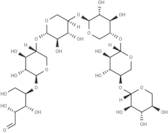
CAS 49694-21-5
:Formula:C30H50O25
InChI:InChI=1S/C30H50O25/c31-7-1-46-26(20(39)13(7)32)52-9-3-48-28(22(41)15(9)34)54-11-5-50-30(24(43)17(11)36)55-12-6-49-29(23(42)18(12)37)53-10-4-47-27(21(40)16(10)35)51-8-2-45-25(44)19(38)14(8)33/h7-44H,1-6H2/t7-,8-,9-,10-,11-,12-,13+,14+,15+,16+,17+,18+,19-,20-,21-,22-,23-,24-,25?,26+,27+,28+,29+,30+/m1/s1
InChI key:FTTUBRHJNAGMKL-HWHAXOAESA-N
SMILES:C1[C@H]([C@@H]([C@H]([C@@H](O1)O[C@@H]2CO[C@H]([C@@H]([C@H]2O)O)O[C@@H]3CO[C@H]([C@@H]([C@H]3O)O)O[C@@H]4CO[C@H]([C@@H]([C@H]4O)O)O[C@@H]5CO[C@H]([C@@H]([C@H]5O)O)O[C@@H]6COC([C@@H]([C@H]6O)O)O)O)O)O
Filter by
Purity percentage
0
100
|
0
|
50
|
90
|
95
|
100
Found 7 products.
- Lower prices
- Higher prices
- Lower purities
- Higher purities
- Faster estimated delivery
(2R,3R,4R)-4-(((2S,3R,4R,5R)-5-(((2S,3R,4R,5R)-5-(((2S,3R,4R,5R)-5-(((2S,3R,4R,5R)-3,4-Dihydroxy-5-(((2S,3R,4S,5R)-3,4,5-trihydroxytetrahydro-2H-pyran-2-yl)oxy)tetrahydro-2H-pyran-2-yl)oxy)-3,4-dihydr
CAS:(2R,3R,4R)-4-(((2S,3R,4R,5R)-5-(((2S,3R,4R,5R)-5-(((2S,3R,4R,5R)-5-(((2S,3R,4R,5R)-3,4-Dihydroxy-5-(((2S,3R,4S,5R)-3,4,5-trihydroxytetrahydro-2H-pyran-2-yl)oxy)tetrahydro-2H-pyran-2-yl)oxy)-3,4-dihydrFormula:C30H50O25Purity:99%Molecular weight:810.71Xylohexaose
CAS:Xylohexaose is an oligosaccharide containing six xylose residues, serving as a substrate for assessing xylan hydrolysis performance.Formula:C30H50O25Purity:99.42%Color and Shape:SolidMolecular weight:810.703Xylohexaose
CAS:(2R,3R,4R)-4-(((2S,3R,4R,5R)-5-(((2S,3R,4R,5R)-5-(((2S,3R,4R,5R)-5-(((2S,3R,4R,5R)-3,4-Dihydroxy-5-(((2S,3R,4S,5R)-3,4,5-trihydroxytetrahydro-2H-pyran-2-yl)oxy)tetrahydro-2H-pyran-2-yl)oxy)-3,4-dihydroxytetrahydro-2H-pyran-2-yl)oxy)-3,4-dihydroxytetrahydro-2H-pyran-2-yl)oxy)-3,4-dihydroxytetrahydro-2H-pyran-2-yl)oxy)-2,3,5-trihydroxypentanalFormula:C30H50O25Purity:99%Molecular weight:810.71,4-β-D-Xylohexaose
CAS:1,4-beta-D-xylohexaose is a sugar that belongs to the group of xylooligosaccharides. It is an enzymatic inactivator that binds to the enzyme hydrolase family. Xylooligosaccharides are found in plant cell walls, where they can be used as a carbon source by termites. 1,4-beta-D-xylohexaose has been shown to be most active against neutral ph, but it is not active against acidic ph. The enzyme hydrolase family is inhibited by binding with 1,4-beta-D-xylohexaose and this prevents hydrolysis of carbohydrates, which includes glycosidic bonds.br>br> 1,4-beta-D-xylohexaose has also been shown to be beneficial for sustainable agriculture practices as it inhibits enzymes that break down xylooligosaccharidesFormula:C30H50O25Purity:Min. 95%Color and Shape:PowderMolecular weight:810.7 g/mol