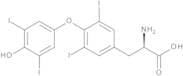
CAS 51-49-0
:D-Thyroxine
Description:
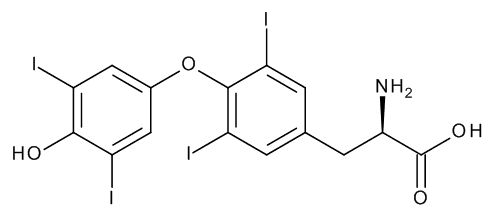
D-Thyroxine, also known as L-thyroxine or T4, is a hormone produced by the thyroid gland that plays a crucial role in regulating metabolism, growth, and development in the body. It is a synthetic form of the naturally occurring hormone and is commonly used in the treatment of hypothyroidism. The chemical formula for D-Thyroxine is C15H11I4N0, and it has a molecular weight of approximately 776.87 g/mol. D-Thyroxine is characterized by its crystalline structure, which is typically white to off-white in appearance. It is soluble in water and alcohol but has limited solubility in organic solvents. The substance is stable under normal conditions but can degrade when exposed to light, heat, or moisture. Its mechanism of action involves binding to thyroid hormone receptors, influencing gene expression and metabolic processes. Due to its significant physiological effects, D-Thyroxine must be administered with caution, and its dosage is carefully monitored in clinical settings to avoid potential side effects associated with thyroid hormone imbalance.
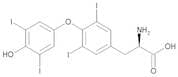
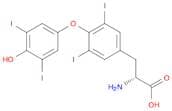
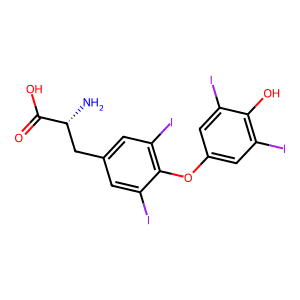
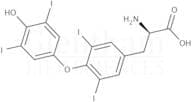
Formula:C15H11I4NO4
InChI:InChI=1S/C15H11I4NO4/c16-8-4-7(5-9(17)13(8)21)24-14-10(18)1-6(2-11(14)19)3-12(20)15(22)23/h1-2,4-5,12,21H,3,20H2,(H,22,23)/t12-/m1/s1
InChI key:InChIKey=XUIIKFGFIJCVMT-GFCCVEGCSA-N
SMILES:O(C1=CC(I)=C(O)C(I)=C1)C2=C(I)C=C(C[C@H](C(O)=O)N)C=C2I
Synonyms:- (R)-2-Amino-3-(4-(4-hydroxy-3,5-diiodophenoxy)-3,5-diiodophenyl)propanoicacid
- 3,3',5,5'-Tetraiodo-D-thyronine
- 3,3′,5,5′-Tetraiodo-<span class="text-smallcaps">D</span>-thyronine
- <span class="text-smallcaps">D</span>-T<sub>4</sub>
- <span class="text-smallcaps">D</span>-Thyroxine
- <span class="text-smallcaps">D</span>-Tyrosine, O-(4-hydroxy-3,5-diiodophenyl)-3,5-diiodo-
- D-4-(4-Hydroxy-3,5-diiodphenoxy)-3,5-diiodbenzylalanin
- D-4-(4-hidroxi-3,5-diiodofenoxi)-3,5-diiodobencilalanina
- D-4-(4-hydroxy-3,5-diiodophenoxy)-3,5-diiodobenzylalanine
- D-T4
- D-Tyrosine, O-(4-hydroxy-3,5-diiodophenyl)-3,5-diiodo-
- D-thyroxine free acid
- Dextrothyroxine
- O-(4-Hydroxy-3,5-diiodophenyl)-3,5-diiodo-<span class="text-smallcaps">D</span>-tyrosine
- O-(4-hydroxy-3,5-diiodophenyl)-3,5-diiodo-D-tyrosine
- O-(4-hydroxy-3,5-diiodophenyl)-3,5-diiodotyrosine
- Thyroxine, <span class="text-smallcaps">D</span>-
- Thyroxine, D-
- See more synonyms
Sort by
Purity (%)
0
100
|
0
|
50
|
90
|
95
|
100
Found 12 products.
(R)-2-Amino-3-(4-(4-hydroxy-3,5-diiodophenoxy)-3,5-diiodophenyl)propanoic acid
CAS:Formula:C15H11I4NO4Purity:95%Color and Shape:SolidMolecular weight:776.8700D-Thyroxine
CAS:D-Thyroxine (Dextroxin) could lower cholesterol and also increases hepatic lipase which in turn improves utilization of triglycerides.Formula:C15H11I4NO4Purity:97.03% - >99.99%Color and Shape:SolidMolecular weight:776.87D-Thyroxine
CAS:D-ThyroxineFormula:C15H11I4NO4Purity:97%Color and Shape: off-white solidMolecular weight:776.87g/molD-Thyroxine
CAS:Controlled ProductApplications One of the thyroid hormones involved in the maintenance of metabolic homeostasis. Synthesized and stored as amino acid residues of thyroglobulin, the major protein component of the thyroid follicular colloid. Synthesis and secretion are regulated by the pituitary hormone (TSH). Deiodinated in peripheral tissues to the active metabolite, liothyronine. The D-form has very little activity as a thyroid hormone, but has been used to treat hyperlipidemia.
References Post, A., et al.: Anal. Profiles Drug Subs., 5, 225 (1976), Nelson, J.C., et al.: Clin. Chem., 34, 1737 (1988), Fischer, D.A., et al.: Clin. Chem., 42, 135 (1996), Cavalieri, R.R., et al.: Thyroid, 7, 177 (1997),Formula:C15H11I4NO4Color and Shape:Off-White To BeigeMolecular weight:776.87