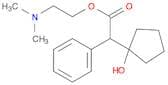
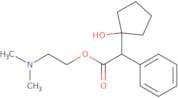
CAS 512-15-2
:Cyclopentolate
Description:
Cyclopentolate is a tertiary amine and a derivative of tropic acid, primarily used as a mydriatic agent in ophthalmology to dilate the pupils during eye examinations. It is characterized by its ability to block the action of acetylcholine at the muscarinic receptors in the iris sphincter muscle, leading to pupil dilation. Cyclopentolate is typically administered as an eye drop solution and has a rapid onset of action, with effects lasting several hours. The compound is known for its relatively low systemic absorption, which minimizes side effects. In terms of physical properties, cyclopentolate is a white to off-white crystalline powder that is soluble in water and exhibits a pH-dependent solubility profile. Its chemical structure includes a cyclopentane ring, contributing to its unique pharmacological properties. As with any medication, it is essential to consider potential side effects, including increased intraocular pressure and sensitivity to light, particularly in susceptible individuals.
Formula:C17H25NO3
InChI:InChI=1S/C17H25NO3/c1-18(2)12-13-21-16(19)15(14-8-4-3-5-9-14)17(20)10-6-7-11-17/h3-5,8-9,15,20H,6-7,10-13H2,1-2H3
InChI key:InChIKey=SKYSRIRYMSLOIN-UHFFFAOYSA-N
SMILES:C(C(OCCN(C)C)=O)(C1(O)CCCC1)C2=CC=CC=C2
Synonyms:- 1-Hydroxy-α-phenylcyclopentaneacetic acid, 2-(dimethylamino)ethyl ester
- 2-(Dimethylamino)Ethyl (1-Hydroxycyclopentyl)(Phenyl)Acetate
- 2-(Dimethylamino)ethyl 2-(1-hydroxycyclopentyl)-2-phenylacetate
- 2-Dimethylaminoethyl 1-hydroxy-α-phenylcyclopentaneacetate
- 2-Dimethylaminoethyl 2-(1-Hydroxycyclopentyl)-2-Phenylacetate
- <span class="text-smallcaps">DL</span>-Cyclopentolate
- Benzeneacetic acid, α-(1-hydroxycyclopentyl)-, 2-(dimethylamino)ethyl ester
- Ciclopentolato
- Cyclogyl
- Cyclopentaneacetic acid, 1-hydroxy-α-phenyl-, 2-(dimethylamino)ethyl ester
- Cyclopentoiate
- Cyclopentolat
- Cyclopentylate
- DL-Cyclopentolate
- Tsiklopentolat
- β-Dimethylaminoethyl (1-hydroxycyclopentyl)phenylacetate
- Mydrilate
- 2-Dimethylaminoethyl 1-hydroxy-alpha-phenylcyclopentaneacetate
- 2-dimethylaminoethyl 2-(1-hydroxycyclopentyl)-2-phenyl-ethanoate
- CYCLOPENTOLATE
- Benzeneacetic acid, a-(1-hydroxycyclopentyl)-, 2-(dimethylamino)ethylester
- 1-Hydroxy-alpha-phenylcyclopentaneacetic acid, 2-(dimethylamino)ethyl ester
- 2-(1-hydroxycyclopentyl)-2-phenyl-acetic acid 2-dimethylaminoethyl ester
- yclopentolate
- Benzeneacetic acid, alpha-(1-hydroxycyclopentyl)-, 2-(dimethylamino)ethyl ester
- α-(1-Hydroxycyclopentyl)benzeneacetic acid 2-(dimethylamino)ethyl
- beta-(Dimethylamino)ethyl (1-hydroxycyclopentyl)phenylacetate
- Cyplegin
- See more synonyms
Sort by
Purity (%)
0
100
|
0
|
50
|
90
|
95
|
100
Found 3 products.
2-(Dimethylamino)ethyl 2-(1-hydroxycyclopentyl)-2-phenylacetate
CAS:Formula:C17H25NO3Molecular weight:291.38532-(Dimethylamino)ethyl 2-(1-hydroxycyclopentyl)-2-phenylacetate
CAS:Formula:C17H25NO3Purity:95.0%Molecular weight:291.391Cyclopentolate
CAS:Controlled ProductCyclopentolate is a muscarinic antagonist and is used as an ophthalmic drug to produce mydriasis. Cyclopentolate inhibits the metabolism of cyclopentyl-CoA via the 3-hydroxyacyl-CoA dehydrogenase, which leads to the accumulation of cyclopentyl-CoA in cells. This inhibition can cause metabolic disorders such as hyperlipidemia and diabetes mellitus, which are characterized by increased acid formation and reduced glucose uptake. Cyclopentolate also binds to DNA, inhibiting transcription, replication, and repair of DNA. The binding affinity of cyclopentolate to DNA is approximately 2500 times higher than that of other drugs in its class. Cyclopentolate has been shown to inhibit leukemia inhibitory factor (LIF) and the production of acid from fluorescein angiographyFormula:C17H25NO3Purity:Min. 95%Color and Shape:White/Off-White SolidMolecular weight:291.39 g/mol