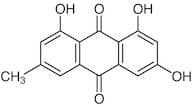
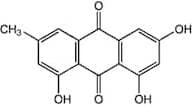
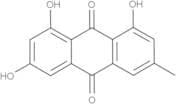
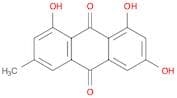
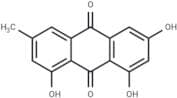
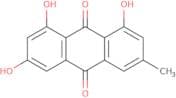
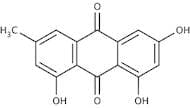
CAS 518-82-1
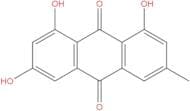
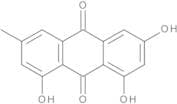
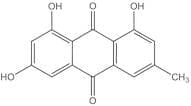
:Emodin
Description:
Emodin is a naturally occurring anthraquinone compound, primarily derived from various plants, including those in the genus Rheum (rhubarb) and Polygonum. It is characterized by its yellow to orange crystalline appearance and has a molecular formula of C15H10O5. Emodin exhibits a range of biological activities, including anti-inflammatory, antioxidant, and anticancer properties, making it of interest in pharmacological research. It is soluble in organic solvents like ethanol and methanol but has limited solubility in water. Emodin's mechanism of action often involves the modulation of various signaling pathways, which contributes to its therapeutic potential. Additionally, it has been studied for its effects on gut health and its role as a laxative. However, while emodin shows promise in various applications, its safety and efficacy in clinical settings require further investigation. As with many natural compounds, the concentration and purity of emodin can vary depending on the source and extraction methods used.
Formula:C15H10O5
InChI:InChI=1S/C15H10O5/c1-6-2-8-12(10(17)3-6)15(20)13-9(14(8)19)4-7(16)5-11(13)18/h2-5,16-18H,1H3
InChI key:InChIKey=RHMXXJGYXNZAPX-UHFFFAOYSA-N
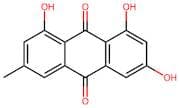
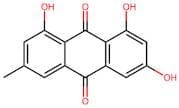
SMILES:O=C1C=2C(C(=O)C=3C1=C(O)C=C(O)C3)=CC(C)=CC2O
Synonyms:- 1,3,8-Trihidroxi-6-Metilantraquinona
- 1,3,8-Trihydroxy-6-methyl-9,10-anthracenedione
- 1,3,8-Trihydroxy-6-methyl-9,10-anthraquinone
- 1,3,8-Trihydroxy-6-methyl-9,10-dihydroanthracene-9,10-dione
- 1,3,8-Trihydroxy-6-methylanthrachinon
- 1,3,8-Trihydroxy-6-methylanthraquinone
- 1,6,8-Trihydroxy-3-methylanthraquinone
- 1,8-Dihydroxy-3-(methoxymethyl)-6-methylanthracene-9,10-dione
- 3-Methyl-1,6,8-trihydroxyanthraquinone
- 4,5,7-Trihydroxy-2-methylanthraquinone
- 6-Methyl-1,3,8-trihydroxyanthraquinone
- 9,10-Anthracenedione, 1,3,8-trihydroxy-6-methyl-
- Anthraquinone, 1,3,8-trihydroxy-6-methyl-
- Archin
- Emodin From Frangula Bark
- Emodine
- Emodol
- Frangula emodin
- Frangulic acid
- Nsc 408120
- Nsc 622947
- Rheum emodin
- Schuttgelb
- See more synonyms
Sort by
Purity (%)
0
100
|
0
|
50
|
90
|
95
|
100
Found 19 products.
Emodin
CAS:Formula:C15H10O5Purity:>96.0%(HPLC)Color and Shape:Orange to Amber to Dark red powder to crystalMolecular weight:270.24Emodin
CAS:A protein tyrosine kinase inhibitorFormula:C15H10O5Color and Shape:Pale brown, PowderMolecular weight:270.24Emodin
CAS:Emodin analytical standard provided with w/w absolute assay, to be used for quantitative titration.Formula:C15H10O5Purity:(HPLC) ≥99%Color and Shape:PowderMolecular weight:270.25EMODIN CRS
CAS:EMODIN CRSFormula:C15H10O5Color and Shape:Orange. Crystalline Powder.Molecular weight:270.2369Emodin (1,3,8-trihydroxy-6-methylanthracene-9,10-dione)
CAS:Quinone drugsFormula:C15H10O5Color and Shape:Yellow PowderMolecular weight:270.052829,10-Anthracenedione, 1,3,8-trihydroxy-6-methyl-
CAS:Formula:C15H10O5Purity:95%Color and Shape:SolidMolecular weight:270.2369Emodin
CAS:Emodin (Frangula emodin) is a selective 11β-HSD1 inhibitor,IC50 of 186 and 86 nM against 11β-HSD1 in humans and mice. High-Quality, Low-Cost!Formula:C15H10O5Purity:98.37% - 99.53%Color and Shape:Physical Description Orange Needles Or Powder (Ntp 1992)Molecular weight:270.24Emodin
CAS:Formula:C15H10O5Purity:≥ 96.0% (dried basis)Color and Shape:Yellow to orange or dark orange powderMolecular weight:270.24Emodin
CAS:Emodin, a natural anthraquinone derivative isolated from Rheum palmatum L., exhibits anti-cancer effect on several human cancers such as liver cancers and lung cancers, treatment with 50 microM emodin resulted in a pronounced release of cytochrome c, activation of caspase-2, -3, and -9, and apoptosis in human lung adenocarcinoma A549 cells.Formula:C15H10O5Purity:95%~99%Color and Shape:Yellow powderMolecular weight:270.24Emodin
CAS:QuinoneFormula:C15H10O5Purity:≥ 90.0 % (HPLC)Color and Shape:PowderMolecular weight:270.241,3,8-Trihydroxy-6-methyl-anthraquinone
CAS:Formula:C15H10O5Purity:95%Color and Shape:Solid, Red to orange powderMolecular weight:270.24Emodin
CAS:Controlled ProductApplications Emodin occurs mostly as the rhamnoside (see Frangulin) in rhubarb root. Cathartic.
References Pan, X., et al.: Biochem. Eng. J., 5, 173 (2000), Srinivas, G., et al.: Eur. J. Pharmacol., 473, 117 (2003), Xiang, H., et al.: Chin. Pharm. J., 40, 96 (2005), Mokhtarani, B., et al.: Biochem. Eng. J., 38, 241 (2008),Formula:C15H10O5Color and Shape:NeatMolecular weight:270.24Emodin
CAS:Inhibits casein kinase 2; anti-inflammatoryFormula:C15H10O5Purity:Min. 95 Area-%Color and Shape:Orange PowderMolecular weight:270.24 g/molEmodin ex. Polygonum Cuspidatum, 90%
CAS:Formula:C15H10O5Purity:min. 90%Color and Shape:Yellow to orange, Crystalline powderMolecular weight:270.24