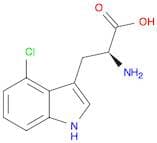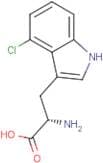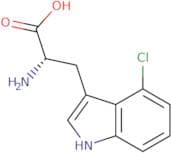
CAS 52448-14-3
:4-Chloro-L-tryptophan
Description:
4-Chloro-L-tryptophan is an amino acid derivative characterized by the presence of a chlorine atom at the fourth position of the indole ring of L-tryptophan. This compound is a non-proteinogenic amino acid, meaning it is not incorporated into proteins during translation. It exhibits properties typical of amino acids, including the ability to form hydrogen bonds and participate in various biochemical reactions. The presence of the chlorine atom can influence its reactivity and interactions with biological molecules, potentially affecting its role in metabolic pathways. 4-Chloro-L-tryptophan is often used in research settings, particularly in studies related to neurotransmitter synthesis and the modulation of serotonin pathways. Its unique structure allows it to serve as a useful tool in biochemical assays and drug development. Additionally, it may exhibit specific pharmacological properties, making it of interest in medicinal chemistry. As with many chemical substances, proper handling and safety precautions are essential due to its potential biological activity.
Formula:C11H11ClN2O2
InChI:InChI=1S/C11H11ClN2O2/c12-7-2-1-3-9-10(7)6(5-14-9)4-8(13)11(15)16/h1-3,5,8,14H,4,13H2,(H,15,16)/t8-/m0/s1
InChI key:InChIKey=NRTHKYABOMUPSC-QMMMGPOBSA-N
SMILES:C([C@@H](C(O)=O)N)C=1C=2C(NC1)=CC=CC2Cl
Synonyms:- L-Tryptophan, 4-chloro-
- (S)-4-Chlorotryptophan
- (2S)-2-Amino-3-(4-chloro-1H-indol-3-yl)propanoic acid
- 4-Chloro-L-tryptophan
Sort by
Purity (%)
0
100
|
0
|
50
|
90
|
95
|
100
Found 4 products.
(S)-2-AMINO-3-(4-CHLORO-1H-INDOL-3-YL)-PROPIONIC ACID
CAS:Formula:C11H11ClN2O2Purity:98%Color and Shape:SolidMolecular weight:238.67024-Chloro-L-tryptophan
CAS:4-Chloro-L-tryptophan is an indole alkaloid that belongs to the group of 2-d nmr. It has a chiral carbon atom and two enantiomers, D and L. 4-Chloro-L-tryptophan is used in the synthesis of serotonin in the brain. Synthesis of serotonin involves a two-step process: first, L-tyrosine is converted to 4-hydroxyphenylpyruvic acid by an aminotransferase enzyme (e.g., phenylalanine aminotransferase), then 4-hydroxyphenylpyruvic acid is converted to 4-chloro-L-tryptophan by a decarboxylase enzyme (e.g., pyridoxal phosphate). The biosynthesis of serotonin also requires an intermediate molecule called indole pyruvic acid.Formula:C11H11ClN2O2Purity:Min. 94 Area-%Color and Shape:PowderMolecular weight:238.67 g/mol