CAS 52766-27-5
:L-Lysyl-L-proline
Description:
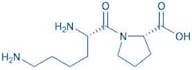
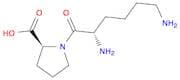
L-Lysyl-L-proline, with the CAS number 52766-27-5, is a dipeptide composed of the amino acids lysine and proline. It is characterized by its specific sequence, where lysine, an essential amino acid, is linked to proline, a non-essential amino acid. This compound is typically found in various biological systems and can play a role in protein synthesis and cellular functions. L-Lysyl-L-proline exhibits properties common to peptides, such as solubility in water and the ability to form hydrogen bonds due to its polar functional groups. Its structure includes an amino group, a carboxyl group, and a side chain characteristic of lysine, which contributes to its basic nature. The presence of proline introduces a unique cyclic structure that can influence the peptide's conformation and stability. L-Lysyl-L-proline may have potential applications in pharmaceuticals and biochemistry, particularly in studies related to protein interactions and metabolic pathways.
Formula:C11H21N3O3
InChI:InChI=1S/C11H21N3O3/c12-6-2-1-4-8(13)10(15)14-7-3-5-9(14)11(16)17/h8-9H,1-7,12-13H2,(H,16,17)/t8-,9-/m0/s1
InChI key:InChIKey=AIXUQKMMBQJZCU-IUCAKERBSA-N
SMILES:C([C@H](CCCCN)N)(=O)N1[C@H](C(O)=O)CCC1
Synonyms:- 205: PN: EP2161028 PAGE: 11 claimed protein
- 21: PN: WO2020097235 SEQID: 250 claimed protein
- 3-4-Substance P
- 37: PN: WO2005081628 SEQID: 1037 claimed protein
- 53: PN: WO2014102101 SEQID: 353 claimed protein
- 53: PN: WO2014102104 SEQID: 152 claimed protein
- <span class="text-smallcaps">L</smallcap>-Lysyl-<smallcap>L</span>-proline
- <span class="text-smallcaps">L</smallcap>-Proline, 1-<smallcap>L</span>-lysyl-
- <span class="text-smallcaps">L</smallcap>-Proline, <smallcap>L</span>-lysyl-
- L-Proline, 1-L-lysyl-
- L-lysyl-L-proline
- Lys-pro
- Lysylproline
- Proline, 1-<span class="text-smallcaps">L</span>-lysyl-
- Substance P<sub>3-4</sub>
- Substance P3-4
- Proline, 1-L-lysyl-
- See more synonyms
Sort by
Purity (%)
0
100
|
0
|
50
|
90
|
95
|
100
Found 4 products.
H-Lys-Pro-OH
CAS:This dipeptide has the potential as a very promising healing agent in ulcer therapy. Daily oral applications to rats accelerated ulcer healing as well by stimulation of angiogenesis as by good mucous regeneration. In mice, a single administration stimulated granulation tissue production.Formula:C11H21N3O3Purity:> 99%Color and Shape:WhiteMolecular weight:243.31Lysylproline
CAS:Lysylproline Third & fourth amino acid in substance P sequence.Formula:C11H21N3O3Color and Shape:SolidMolecular weight:243.3H-Lys-Pro-OH hydrochloride salt
CAS:H-Lys-Pro-OH hydrochloride salt is a monoclonal antibody that is used to treat psychotic disorders. It blocks the binding of gamma-aminobutyric acid (GABA) to its receptor, which reduces neuronal activity and has a calming effect on the central nervous system. H-Lys-Pro-OH hydrochloride salt also inhibits the phosphatase enzyme and prevents it from breaking down phosphotungstic acid, which is used in this process. The antibody also binds to the analog of gamma aminobutyric acid, preventing it from binding with its receptor. H-Lys-Pro-OH hydrochloride salt may be advantageous in treating kidney fibrosis because it prevents cell proliferation and growth in tissue cultures by inhibiting enzymes involved in collagen synthesis. H-Lys-Pro-OH hydrochloride salt may also be useful as an antitumor agent because it inhibits tumor growth by blocking uptake and replication of DNA.Formula:C11H21N3O3Purity:Min. 95%Molecular weight:243.3 g/mol