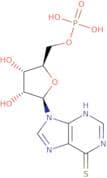
CAS 53-83-8
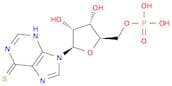
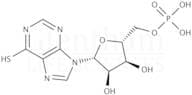
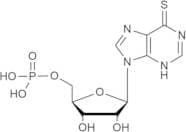
:6-Thioinosinic acid
- 5'-Inosinic acid, 6-thio- (9CI)
- 5′-Inosinic acid, 6-thio-
- 6-Mercaptopurine ribo-5′-monophosphate
- 6-Mercaptopurine ribonucleoside 5′-phosphate
- 6-Mercaptopurine ribonucleoside monophosphate
- 6-Mercaptopurine ribonucleotide
- 6-Mercaptopurine riboside 5'-monophosphate
- 6-Mercaptopurine riboside 5'-phosphate
- 6-Mercaptopurine riboside phosphate
- 6-Mercaptopurine ribotide
- 6-Thio-5′-inosinic acid
- 6-Thio-IMP
- 6-Thioinosine 5'-phosphate (VAN)
- 6-Thioinosine 5′-phosphate
- 6-Thioinosine 5′-phosphoric acid
- 6-Thioinosinic acid
- 9-(5-O-phosphono-beta-D-ribofuranosyl)-3,9-dihydro-6H-purine-6-thione
- 9-(5-O-phosphonopentofuranosyl)-3,9-dihydro-6H-purine-6-thione
- 9H-Purine-6-thiol, 9-beta-D-ribofuranosyl-, 5'-(dihydrogen phosphate) (8CI)
- 9H-Purine-6-thiol, 9-β-<span class="text-smallcaps">D</span>-ribofuranosyl-, 5′-(dihydrogen phosphate)
- 9H-Purine-6-thiol, 9-β-<span class="text-smallcaps">D</span>-ribofuranosyl-, 5′-phosphate
- Nsc 520722
- Thio-IMP
- Thioinosinic acid
- 9H-Purine-6-thiol, 9-β-D-ribofuranosyl-, 5′-(dihydrogen phosphate)
- See more synonyms
6-Thioinosine Phosphate (~90%)
CAS:Formula:C10H13N4O7PSPurity:90%Color and Shape:SolidMolecular weight:364.27166-Thioinosine Phosphate (>85%)
CAS:Controlled ProductStability Hygroscopic
Applications A metabolite of 6-Mercaptopurine.
References Parker, W., et al.: Cancer Res., 51, 2386 (1991) , Munagala, N., et al.: J. Biol. Chem., 275, 37072 (2000), Guddat, L., et al.: Protein Sci., 11, 1626 (2002), Pinkel, D., et al.: J. Clin. Oncol., 11, 1826 (1993), Tripathy, D., et al.: Oncologist, 12, 375 (2007),Formula:C10H13N4O7PSPurity:>85%Color and Shape:NeatMolecular weight:364.276-Thioinosine 5'-monophosphate
CAS:6-Thioinosine 5'-monophosphate (6TIMP) is a hydrogen bond donor that possesses inhibitory properties against protein synthesis. It has been shown to have an anti-inflammatory effect and can be used for the treatment of inflammatory bowel disease. 6TIMP is also able to inhibit the bcr-abl kinase, which is implicated in the development of renal cell cancer. 6TIMP can be administered intravenously or orally and penetrates tissues well. The rate at which it enters cells is dependent on the transport rate, which is determined by its acidity. 6TIMP has been shown to cause DNA damage, leading to apoptosis and cell death in carcinoma cell lines. The mechanism of action appears to involve inhibition of cellular protein synthesis, acid formation, and DNA damage.
Formula:C10H13N4O7PSPurity:Min. 95%Color and Shape:PowderMolecular weight:364.27 g/molRef: 3D-NT10843
Discontinued product