CAS 5518-52-5
:Tri(2-furyl)phosphine
Description:
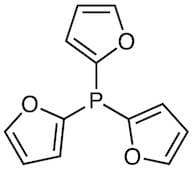
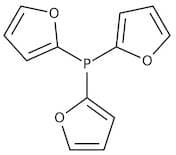
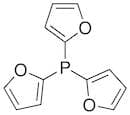
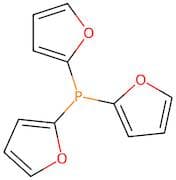
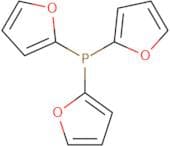
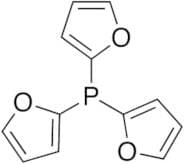
Tri(2-furyl)phosphine is an organophosphorus compound characterized by the presence of three 2-furyl groups attached to a central phosphorus atom. This compound typically appears as a colorless to pale yellow liquid or solid, depending on its purity and temperature. It is known for its distinctive aromatic properties due to the furan rings, which contribute to its reactivity and potential applications in organic synthesis and coordination chemistry. Tri(2-furyl)phosphine can act as a ligand in coordination complexes, facilitating the formation of metal-ligand interactions. Its structure allows for various chemical reactions, including oxidation and coordination with transition metals. Additionally, it may exhibit interesting electronic properties due to the conjugated system of the furan rings. Safety considerations should be taken into account when handling this compound, as it may pose health risks if inhaled or ingested. Overall, tri(2-furyl)phosphine is a valuable compound in the field of organophosphorus chemistry, with potential applications in catalysis and materials science.
Formula:C12H9O3P
InChI:InChI=1/C12H9O3P/c1-4-10(13-7-1)16(11-5-2-8-14-11)12-6-3-9-15-12/h1-9H
SMILES:c1cc(oc1)P(c1ccco1)c1ccco1
Synonyms:- Phosphine, tri-2-furanyl-
- Tri-2-furylphosphine
- Tris-furan-2-yl-phosphine
- Trifuran-2-Ylphosphane
Sort by
Purity (%)
0
100
|
0
|
50
|
90
|
95
|
100
Found 9 products.
Tri(2-furyl)phosphine
CAS:Formula:C12H9O3PPurity:>98.0%(GC)Color and Shape:White to Yellow to Orange powder to crystalMolecular weight:232.17Tri(2-furyl)phosphine, 97%
CAS:This Thermo Scientific Chemicals brand product was originally part of the Alfa Aesar product portfolio. Some documentation and label information may refer to the legacy brand. The original Alfa Aesar product / item code or SKU reference has not changed as a part of the brand transition to Thermo SciFormula:C12H9O3PPurity:97%Color and Shape:White to cream to pale brown or yellow to orange, Crystals or powder or crystalline powder or fused solidMolecular weight:232.18Tri-2-furylphosphine, 98+%
CAS:Tri-2-furylphosphine, 98+%
Formula:(C4H3O)3PPurity:98+%Color and Shape:white pwdr.Molecular weight:232.17Tri(fur-2-yl)phosphine
CAS:Tri(fur-2-yl)phosphineFormula:C12H9O3PPurity:≥95%Color and Shape: white solidMolecular weight:232.17g/molTri(2-furyl)phosphine
CAS:Tri(2-furyl)phosphine (TFP) is a homogeneous catalyst that catalyzes the palladium-catalyzed coupling of aryl bromides and chlorides to form new chiral organic molecules. The reaction mechanism involves the formation of an activated Pd(0) species, which is converted to a Pd(II) species by the addition of a nucleophile. TFP also has been used in asymmetric synthesis, as it can be used for the synthesis of diastereomeric alcohols, nitriles, amines and amino acids. The use of TFP in cross-coupling reactions has been reported to be both reactive and selective. It has been shown that TFP can be used to synthesize ferrocenecarboxylic acid and chloride derivatives. TFP is also able to cleave prochiral bonds with trifluoroacetic acid or hydrogen bonding interactions with chloride ions.Formula:C12H9O3PPurity:Min. 97.5%Color and Shape:PowderMolecular weight:232.17 g/molTri(2-furyl)phosphine
CAS:Controlled ProductApplications A phopshine ligand used in transition-metal mediated organic synthesis, in particular in wittig reactions to improved (Z) selectivity.
References Andersen N.G. et al.: Chem. Rev., 101, 997 (2001); Appel M. et al.: Eur. J. Org. Chem., 1143, (2002);Formula:C12H9O3PColor and Shape:NeatMolecular weight:232.17