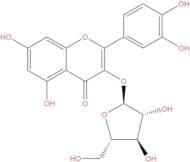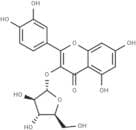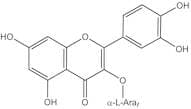
CAS 572-30-5
:avicularin
Description:
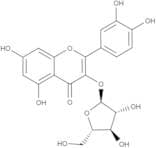
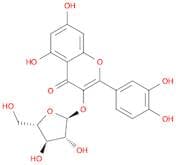
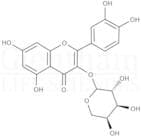
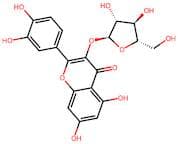
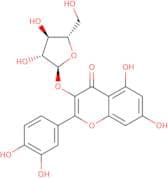
Avicularin, with the CAS number 572-30-5, is a flavonoid glycoside primarily derived from various plant sources, particularly those in the family of the genus *Euphorbia*. It is characterized by its chemical structure, which includes a flavone backbone with a sugar moiety, typically rhamnose. Avicularin exhibits a range of biological activities, including antioxidant, anti-inflammatory, and potential antimicrobial properties, making it of interest in pharmacological research. Its solubility is generally moderate in polar solvents, and it can be identified through various spectroscopic methods, including UV-Vis and NMR spectroscopy. The compound's potential health benefits are attributed to its ability to scavenge free radicals and modulate various biochemical pathways. Additionally, avicularin has been studied for its role in traditional medicine, particularly in herbal remedies. However, further research is necessary to fully elucidate its mechanisms of action and therapeutic potential.
Formula:C20H18O11
InChI:InChI=1/C20H18O11/c21-8-4-11(24)14-13(5-8)30-18(7-1-2-9(22)10(23)3-7)19(16(14)27)31-20-17(28)15(26)12(25)6-29-20/h1-5,12,15,17,20-26,28H,6H2/t12-,15-,17+,20?/m0/s1
InChI key:InChIKey=BDCDNTVZSILEOY-UXYNSRGZSA-N
SMILES:O(C1=C(OC=2C(C1=O)=C(O)C=C(O)C2)C3=CC(O)=C(O)C=C3)[C@@H]4O[C@@H](CO)[C@H](O)[C@H]4O
Synonyms:- 3-(α-<span class="text-smallcaps">L</span>-Arabinofuranosyloxy)-2-(3,4-dihydroxyphenyl)-5,7-dihydroxy-4H-1-benzopyran-4-one
- 4H-1-Benzopyran-4-one, 3-(alpha-L-arabinofuranosyloxy)-2-(3,4-dihydroxyphenyl)-5,7-dihydroxy-
- 4H-1-Benzopyran-4-one, 3-(α-<span class="text-smallcaps">L</span>-arabinofuranosyloxy)-2-(3,4-dihydroxyphenyl)-5,7-dihydroxy-
- Avicularine
- Avicularoside
- Quercetin 3-O-α-<span class="text-smallcaps">L</span>-arabinofuranoside
- Quercetin 3-α-<span class="text-smallcaps">L</span>-arabinofuranoside
- 4H-1-Benzopyran-4-one, 3-(α-L-arabinofuranosyloxy)-2-(3,4-dihydroxyphenyl)-5,7-dihydroxy-
- Quercetin 3-α-L-arabinofuranoside
- Avicularin
- 3-(α-L-Arabinofuranosyloxy)-2-(3,4-dihydroxyphenyl)-5,7-dihydroxy-4H-1-benzopyran-4-one
- QUERCETIN-3-ARABINOSIDE
- 3,3′,4′,5,7-Pentahydroxyflavone 3-O-α-L-arabinofuranoside
- Avicularin(Quercetin 3-alpha-L-arabinofuranoside)
- Avicularin, 98%, from Polygonum aviculare L.
- 3-[(2S,3R,4R,5S)-3,4-dihydroxy-5-(hydroxymethyl)oxolan-2-yl]oxy-2-(3,4-dihydroxyphenyl)-5,7-dihydroxychromen-4-one
- Fenicularin
- QUERCETIN-3-ARABINOSIDE hplc
- See more synonyms
Sort by
Purity (%)
0
100
|
0
|
50
|
90
|
95
|
100
Found 11 products.
Avicularin
CAS:Avicularin analytical standard provided with chromatographic purity, to be used as reference material for qualitative determination.Formula:C20H18O11Purity:(HPLC) ≥96%Color and Shape:PowderMolecular weight:434.36Avicularin
CAS:Formula:C20H18O11Purity:≥ 98.0%Color and Shape:White to yellow powderMolecular weight:434.35Avicularin
CAS:Avicularin exhibits anti-inflammatory activity through the suppression of ERK signaling pathway in LPS-stimulated RAW 264.7 macrophage cells; it inhibits the accumulation of the intracellular lipids by decreasing C/EBPα-activated GLUT4-mediated glucose uptake in adipocytes and potently inhibiting fatty acid synthase.Formula:C20H18O11Purity:95%~99%Molecular weight:434.353Avicularin
CAS:Avicularin reduces inflammation via ERK pathway in RAW 264.7 cells and hinders lipid buildup in adipocytes by limiting glucose uptake and fatty acid synthesis.Formula:C20H18O11Purity:97.02% - 99.94%Color and Shape:White PowderMolecular weight:434.35Ref: TM-T6S0117
1mg55.00€5mg92.00€1mL*10mM (DMSO)105.00€10mg152.00€25mg268.00€50mg395.00€100mg583.00€200mg832.00€Avicularin
CAS:Natural glycosideFormula:C20H18O11Purity:≥ 95.0 % (HPLC)Color and Shape:PowderMolecular weight:434.36Quercetin-3-arabinoside
CAS:Quercetin-3-arabinoside is a flavonoid glycoside, which is a naturally occurring compound found in various plants including fruits and vegetables. It is derived from quercetin, a flavonoid widely distributed in the plant kingdom. The arabinoside component is a sugar moiety that enhances the solubility and stability of the compound. Quercetin-3-arabinoside exerts its effects through antioxidant activity, where it scavenges free radicals and chelates metal ions, thus protecting cells from oxidative stress and potential damage.
Formula:C20H18O11Purity:Min. 95%Color and Shape:PowderMolecular weight:434.35 g/molRef: 3D-FQ65464
Discontinued product