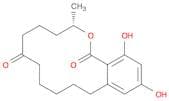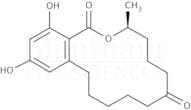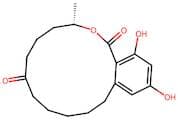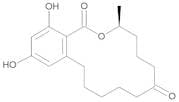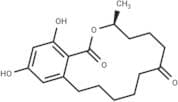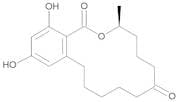
CAS 5975-78-0
:Zearalanone
- (3S)-14,16-dihydroxy-3-methyl-3,4,5,6,9,10,11,12-octahydro-1H-2-benzoxacyclotetradecine-1,7(8H)-dione
- (3S)-3,4,5,6,9,10,11,12-Octahydro-14,16-dihydroxy-3-methyl-1H-2-benzoxacyclotetradecin-1,7(8H)-dione
- (S)-3,4,5,6,9,10,11,12-Octahydro-14,16-dihydroxy-3-methyl-1H-2-benzoxacyclotetradecin-1,7(8H)-dione
- (S)-Zearalanone
- 14,16-dihydroxy-3-methyl-3,4,5,6,9,10,11,12-octahydro-1H-2-benzoxacyclotetradecine-1,7(8H)-dione
- 1H-2-Benzoxacyclotetradecin-1,7(8H)-dione, 3,4,5,6,9,10,11,12-octahydro-14,16-dihydroxy-3-methyl-, (3S)-
- 1H-2-Benzoxacyclotetradecin-1,7(8H)-dione, 3,4,5,6,9,10,11,12-octahydro-14,16-dihydroxy-3-methyl-, (S)-
- Ccris 9235
- P 1502
- Zanone
- beta-Resorcylic acid, 6-(10-hydroxy-6-oxoundecyl)-, mu-lactone
- β-Resorcylic acid, 6-(10-hydroxy-6-oxoundecyl)-, μ-lactone
- Zearalanone
- Zearalanone (Certified Reference Material)
- Zearalanone solution
- 2,4-Dihydroxy-6-(10-hydroxy-6-oxoundecyl)benzoic acid μ-lactone solution
- (S)-Zearalanone, P 1502, Zanone
- 2-[(S)-10-Hydroxy-6-oxoundecyl]-4,6-dihydroxybenzoic acid 1,2-lactone
- Zearalanone,2,4-Dihydroxy-6-(10-hydroxy-6-oxoundecyl)benzoic acid μ-lactone
- Zearalanone Standard
- 2,4-Dihydroxy-6-(10-hydroxy-6-oxoundecyl)benzoic acid μ-lactone
- See more synonyms
Zearalanone 10 µg/mL in Acetonitrile
CAS:Controlled ProductFormula:C18H24O5Color and Shape:Single SolutionMolecular weight:320.38Fusarium Toxins Mixture 10-100 µg/mL in Acetonitrile
CAS:Controlled ProductColor and Shape:Colourless LiquidA + B-Trichothecenes and Zearalenone Mixture 10 µg/mL in Acetonitrile
CAS:Controlled ProductColor and Shape:MixtureZearalanone
CAS:Zearalenone is a nonsteroidal estrogenic mycotoxin produced by Fusarium species, which colonizes several grains.Formula:C18H24O5Purity:98%Color and Shape:SolidMolecular weight:320.38(S)-Zearalanone
CAS:Controlled ProductApplications A secondary metabolite of Zearalenone (ZON). The macrocyclic lactone Zearalanone used in the synthesis of d,l-Zearalanol.
References Hurd, R.N., et al.: J. Med. Chem., 16(5), 543 (1973), Baughman, R., et al.: Science, 297, 787 (2002), Zinedine, A., et al.: Food Chem. Toxicol., 45, 1 (2007), Chailapakul, O., et al.: Food Chem., 109, 876 (2008),Formula:C18H24O5Color and Shape:White To Off-WhiteMolecular weight:320.38Zearalanone
CAS:Zearalanone is a mycotoxin that is produced by certain species of the Fusarium fungi. This compound is structurally related to the known mycotoxin zearalenone, and it exhibits similar functionalities. It is primarily found in grains such as maize, barley, oats, wheat, and rice that have been contaminated by these fungi. The mode of action of zearalanone involves its mimicry of estrogenic activity. It binds to estrogen receptors in various tissues, disrupting normal endocrine functions. This disruption can have significant implications in both human and animal health, leading to reproductive issues and developmental anomalies.
Purity:Min. 95%