CAS 59880-97-6
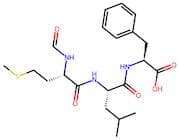
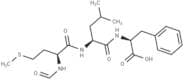
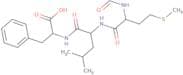
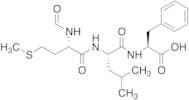
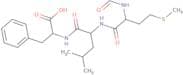
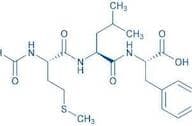
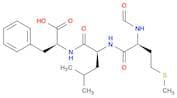
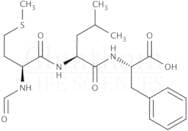
:N-Formyl-L-methionyl-L-leucyl-L-phenylalanine
Description:
N-Formyl-L-methionyl-L-leucyl-L-phenylalanine, with the CAS number 59880-97-6, is a synthetic peptide that consists of three amino acids: methionine, leucine, and phenylalanine, with a formyl group attached to the amino terminus of the methionine residue. This compound is characterized by its specific sequence of amino acids, which contributes to its biological activity and potential applications in biochemical research. Peptides like this one often exhibit properties such as solubility in polar solvents, stability under physiological conditions, and the ability to interact with biological receptors or enzymes. The presence of the formyl group can influence the peptide's reactivity and its role in various biochemical pathways. N-Formyl-L-methionyl-L-leucyl-L-phenylalanine may also serve as a model compound for studying peptide synthesis, structure-activity relationships, and the mechanisms of peptide-mediated signaling in biological systems. Its unique structure makes it a subject of interest in fields such as medicinal chemistry and pharmacology.
Formula:C8H12ClNO
InChI:InChI=1/C21H31N3O5S/c1-14(2)11-17(23-19(26)16(22-13-25)9-10-30-3)20(27)24-18(21(28)29)12-15-7-5-4-6-8-15/h4-8,13-14,16-18H,9-12H2,1-3H3,(H,22,25)(H,23,26)(H,24,27)(H,28,29)/t16-,17-,18-/m0/s1
InChI key:InChIKey=PRQROPMIIGLWRP-BZSNNMDCSA-N
SMILES:[C@H](C(N[C@@H](CC1=CC=CC=C1)C(O)=O)=O)(NC([C@H](CCSC)NC=O)=O)CC(C)C
Synonyms:- 3: PN: WO2010089019 PAGE: 22 claimed protein
- 4-(2-Aminoethyl)Phenol Hydrochloride (1:1)
- 4-Hydroxy-phenethylamine hydrochloride
- <span class="text-smallcaps">L</smallcap>-Phenylalanine, N-[N-(N-formyl-<smallcap>L</smallcap>-methionyl)-<smallcap>L</span>-leucyl]-
- <span class="text-smallcaps">L</smallcap>-Phenylalanine, N-formyl-<smallcap>L</smallcap>-methionyl-<smallcap>L</span>-leucyl-
- For-Met-Leu-Phe-OH
- Formyl-Met-Leu-Phe-OH
- N-Formyl-<span class="text-smallcaps">L</smallcap>-methionyl-<smallcap>L</smallcap>-leucyl-<smallcap>L</span>-phenylalanine
- N-Formyl-Met-Leu-Phe
- N-Formyl-Met-Leu-Phe-OH
- N-Formyl-methionyl-leucyl-phenylalanine
- N-formylmethionylleucylphenylalanine
- NSC 350593
- L-Phenylalanine, N-formyl-L-methionyl-L-leucyl-
- L-Phenylalanine, N-[N-(N-formyl-L-methionyl)-L-leucyl]-
- N-Formyl-L-methionyl-L-leucyl-L-phenylalanine
- fMLF
- 4-HYDROXYPHENYLETHYLAMINE HCL
- 4-HYDROXYPHENETHYLAMINE HYDROCHLORIDE
- fMLP (misnomer but widely used)
- F-MET-LEU-PHE
- TYRAMINE MONOHYDROCHLORIDE
- 4-(2-AMINOETHYL)PHENOL HYDROCHLORIDE
- P-HYDROXYPHENETHYLAMINE HYDROCHLORIDE
- TYRAMINE HCL(P)
- TYRAMINE HCL
- TIMTEC-BB SBB003808
- P-(2-AMINOETHYL)PHENOL HYDROCHLORIDE
- 2-(4-HYDROXYPHENYL)ETHYLAMMONIUM CHLORIDE
- TYROSAMINE HCL
- TYROSAMINE HYDROCHLORIDE
- TYRAMINE
- 2-(4-HYDROXYPHENYL)ETHYLAMINE HYDROCHLORIDE
- 4-HYDROXYPHENYLETHYLAMINE HYDROCHLORIDE
- 2-(4-HYDROXYPHENYL)ETHYLAMINE HCL
- See more synonyms
Sort by
Purity (%)
0
100
|
0
|
50
|
90
|
95
|
100
Found 14 products.
N-Formyl-L-methionyl-L-leucyl-L-phenylalanine
CAS:Formula:C21H31N3O5SPurity:>98.0%(HPLC)Color and Shape:White to Almost white powder to crystalMolecular weight:437.56Chemotactic Peptide
CAS:For cellular and molecular biology applicationsFormula:C21H31N3O5SColor and Shape:White to pale cream, Lyophilized PowderMolecular weight:437.56TYRAMINE HYDROCHLORIDE
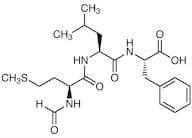
CAS:Formula:C21H31N3O5SPurity:97%Color and Shape:SolidMolecular weight:437.5529N-formyl-[U-13C-15N]-Met-Leu-Phe-OH
CAS:N-formyl-[U-13C-15N]-Met-Leu-Phe-OHPurity:98%Molecular weight:437.55g/molN-Formyl-Met-Leu-Phe
CAS:N-Formyl-Met-Leu-Phe (N-Formyl-MLF) (fMLF) is a synthetic peptide that acts as an agonist at formyl peptide receptors (FPR; Ki = 0.8 pM).Formula:C21H31N3O5SPurity:98.69% - 98.69%Color and Shape:SolidMolecular weight:437.55N-Formyl-Met-Leu-Phe
CAS:Custom research peptide; min purity 95%. For different specs please use the Peptide Quote ToolFormula:C21H31N3O5SMolecular weight:437.6 g/molChemotactic Peptide
CAS:As a chemotactic peptide, For-Met-Leu-Phe (FMLP) has chemotactic properties, which means it can attract cells. For example it is a chemoattractant for phagocytic leukocytes and neutrophils. Neutrophils which have seven transmembrane G-protein coupled receptors are activated during the acute inflammatory response by FMLP and other chemotactic factors which bind to its surface receptors. This results in the activate of NF- κB, MAPK and PI3K pathways. In particular FMLP is known to induce Interleukin-8 (IL-8) which is responsible for both tissue damage and the pathogenesis of inflammatory processes resulting from neutrophils. Chemotactic peptide have been used to study the function of polymorphonuclear leukocytes and other white blood cells in inflammation. Chemotactic peptides are often used as fluorescent probes to measure intracellular metabolic responses to chemoattractant stimulation. This product is available as a 0.5mg vial.Formula:C21H31N3O5SPurity:Min. 95%Molecular weight:437.55 g/molN-Formyl-Met-Leu-Phe
CAS:Controlled ProductApplications N-Formyl-Met-Leu-Phe is an inducer of superoxide release and agonist for FPR1.
Formula:C21H31N3O5SColor and Shape:NeatMolecular weight:437.55Chemotactic Peptide
CAS:Chemotactic peptides are peptides that possess chemotactic properties, which means they attract cells. One well-known chemotactic peptide is For-Met-Leu-Phe (FMLP) and is a chemoattractant for phagocytic leukocytes and neutrophils. During the acute inflammatory response chemotactic factors activate neutrophils which have seven transmembrane G-protein coupled receptors. FMLP bind to these G-protein coupled receptors on the surface of neutrophils and activate NF- κB, MAPK and PI3K pathways. In particular FMLP is known to induce Interleukin-8 (IL-8) which is responsible for both tissue damage and the pathogenesis of inflammatory processes resulting from neutrophils. Chemotactic peptide have been used to study the function of polymorphonuclear leukocytes and other white blood cells in inflammation. Chemotactic peptides are often used as fluorescent probes to measure intracellular metabolic responses to chemoattractant stimulation.Formula:C21H31N3O5SPurity:Min. 95%Molecular weight:437.55 g/molFor-Met-Leu-Phe-OH
CAS:There is evidence that pretreatment of human polymorphonuclear neutrophils (PMN) with fMLF results in the inhibition of TNF-α secretion, which indicates that this typical proinflammatory agent could play, at least at determined conditions, an antiinflammatory role.Formula:C21H31N3O5SPurity:99.7%Color and Shape:White PowderMolecular weight:437.56





![N-formyl-[U-13C-15N]-Met-Leu-Phe-OH](/_next/image/?url=https%3A%2Fstatic.cymitquimica.com%2Fproducts%2F54%2Fthumb%2FOR1023295.jpg&w=3840&q=75)