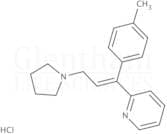
CAS 6138-79-0
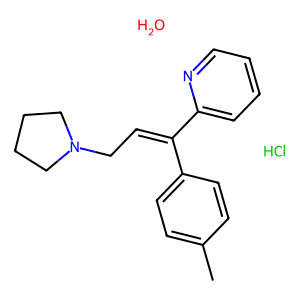
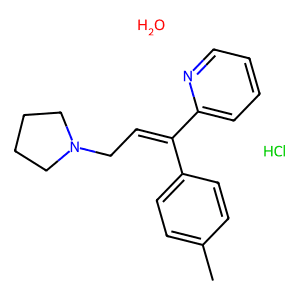
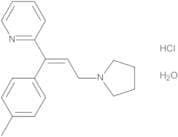
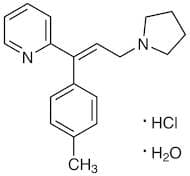
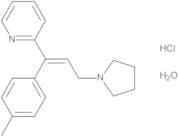
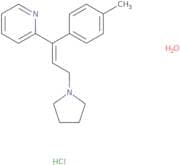
:Triprolidine hydrochloride monohydrate
Description:
Triprolidine hydrochloride monohydrate is an antihistamine used primarily for the relief of allergy symptoms, such as runny nose, sneezing, and itching. It is classified as a first-generation antihistamine, which means it can cross the blood-brain barrier, potentially leading to sedative effects. The chemical structure of triprolidine includes a piperidine ring, contributing to its pharmacological properties. As a hydrochloride salt, it is typically more soluble in water than its free base form, enhancing its bioavailability. The monohydrate form indicates the presence of one molecule of water associated with each molecule of the compound, which can influence its stability and solubility. Triprolidine is known for its relatively long duration of action compared to other first-generation antihistamines, making it effective for prolonged symptom relief. However, it may also cause side effects such as drowsiness, dry mouth, and dizziness. As with any medication, it is essential to use triprolidine under medical supervision to manage potential interactions and contraindications effectively.
Formula:C19H22N2·ClH·H2O
InChI:InChI=1S/C19H22N2.ClH.H2O/c1-16-7-9-17(10-8-16)18(19-6-2-3-12-20-19)11-15-21-13-4-5-14-21;;/h2-3,6-12H,4-5,13-15H2,1H3;1H;1H2/b18-11+;;
InChI key:InChIKey=CUZMOIXUFHOLLN-UMVVUDSKSA-N
SMILES:C(=C\CN1CCCC1)(\C2=CC=C(C)C=C2)/C3=CC=CC=N3.Cl.O
Synonyms:- 1-[(2E)-3-(4-methylphenyl)-3-pyridin-2-ylprop-2-en-1-yl]pyrrolidinium chloride hydrate
- Pyridine, 2-[(1E)-1-(4-methylphenyl)-3-(1-pyrrolidinyl)-1-propen-1-yl]-, hydrochloride, hydrate (1:1:1)
- Pyridine, 2-[(1E)-1-(4-methylphenyl)-3-(1-pyrrolidinyl)-1-propenyl]-, monohydrochloride, monohydrate
- Pyridine, 2-[1-(4-methylphenyl)-3-(1-pyrrolidinyl)-1-propenyl]-, monohydrochloride, monohydrate, (E)-
- Pyridine, 2-[3-(1-pyrrolidinyl)-1-p-tolylpropenyl]-, monohydrochloride, monohydrate, stereoisomer
- Triprolidine hydrochloride monohydrate
Sort by
Purity (%)
0
100
|
0
|
50
|
90
|
95
|
100
Found 12 products.
Triprolidine Hydrochloride
CAS:Compounds containing an unfused pyridine ring in the structure, nesoiFormula:C19H22N2·ClH·H2OColor and Shape:White Crystalline PowderMolecular weight:332.16554Pyridine, 2-[(1E)-1-(4-methylphenyl)-3-(1-pyrrolidinyl)-1-propen-1-yl]-, hydrochloride, hydrate (1:1:1)
CAS:Formula:C19H25ClN2OPurity:99%Color and Shape:SolidMolecular weight:332.8676Triprolidine hydrochloride monohydrate
CAS:Triprolidine hydrochloride monohydrate is a histamine H1 antagonist used in allergic rhinitis, asthma.Formula:C19H25ClN2OPurity:99.68% - 99.81%Color and Shape:White Crystalline PowderMolecular weight:332.87Triprolidine hydrochloride
CAS:Formula:C19H22N2·HClPurity:≥ 99.0%Color and Shape:White to light-yellow crystalline powderMolecular weight:314.85Triprolidine Hydrochloride Monohydrate
CAS:Triprolidine Hydrochloride MonohydratePurity:99%Molecular weight:332.87g/molTriprolidine hydrochloride monohydrate
CAS:Triprolidine hydrochloride monohydratePurity:≥95%Molecular weight:332.87g/molTriprolidine Hydrochloride Monohydrate
CAS:Formula:C19H22N2·HCl·H2OPurity:>98.0%(T)(HPLC)Color and Shape:White to Light yellow powder to crystalMolecular weight:332.88trans-Triprolidine Hydrochloride
CAS:Controlled ProductFormula:C19H22N2·HCl·H2OColor and Shape:NeatMolecular weight:332.87Triprolidine Hydrochloride Monohydrate
CAS:Formula:C19H22N2HClH2OMolecular weight:278.4 : 36.46 : 18.0Triprolidine HCl
CAS:Triprolidine is a medicine that belongs to the class of medicines known as antihistamines. It is used to relieve symptoms associated with allergic reactions such as hay fever, asthma and other respiratory allergies. Triprolidine HCl is used in the treatment of pain, including cancer pain and bone cancer pain. This drug also has a potential use in treating or preventing cancerous cells from spreading to other body parts. The most common side effects reported by people who take triprolidine are headache, dry mouth, dizziness, and drowsiness. Triprolidine HCl is available in tablet form for oral administration at doses of 0.25 mg, 0.5 mg, 1 mg, 2 mg, 3 mg and 4 mg. The recommended effective dose for adults is 1mg taken every 12 hours orally or every six hours when needed for a maximum of five days unless directed otherwise by a physician. The absorption of triprolidine HCl into theFormula:C19H22N2HClPurity:Min. 95%Molecular weight:314.85 g/mol


![Pyridine, 2-[(1E)-1-(4-methylphenyl)-3-(1-pyrrolidinyl)-1-propen-1-yl]-, hydrochlo…](/_next/image/?url=https%3A%2Fstatic.cymitquimica.com%2Fproducts%2FIN%2Fthumb%2FDA01E4US.jpg&w=3840&q=75)