CAS 62004-35-7
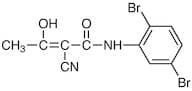
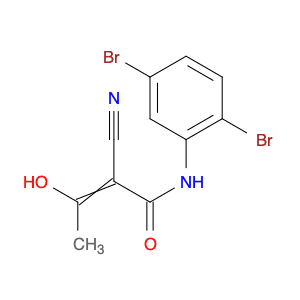
:(Z)-2-cyano-N-(2,5-dibromophenyl)-3-hydroxy-but-2-enamide
Description:
(Z)-2-cyano-N-(2,5-dibromophenyl)-3-hydroxy-but-2-enamide is a chemical compound characterized by its unique structural features, including a cyano group, a hydroxyl group, and an amide functional group. The presence of the dibromophenyl moiety contributes to its potential reactivity and biological activity, as halogenated compounds often exhibit distinct properties. The (Z) configuration indicates that the substituents around the double bond are on the same side, which can influence the compound's stereochemistry and interactions with biological targets. This compound may exhibit various properties such as solubility in organic solvents, potential for hydrogen bonding due to the hydroxyl group, and the ability to participate in nucleophilic reactions due to the cyano group. Its specific applications and biological activities would depend on further studies, but compounds with similar structures are often explored in medicinal chemistry for their potential therapeutic effects. As with any chemical substance, safety and handling precautions should be observed due to the presence of bromine, which can pose environmental and health risks.
Formula:C11H8Br2N2O2
InChI:InChI=1/C11H8Br2N2O2/c1-6(16)8(5-14)11(17)15-10-4-7(12)2-3-9(10)13/h2-4,16H,1H3,(H,15,17)/b8-6-
SMILES:C/C(=C(\C#N)/C(=Nc1cc(ccc1Br)Br)O)/O
Synonyms:- (2Z)-2-cyano-N-(2,5-dibromophenyl)-3-hydroxybut-2-enamide
- Lfm-A13
Sort by
Purity (%)
0
100
|
0
|
50
|
90
|
95
|
100
Found 4 products.
LFM-A13
CAS:Formula:C11H8Br2N2O2Purity:>98.0%(HPLC)Color and Shape:Light yellow to Brown powder to crystalMolecular weight:360.012-Butenamide, 2-cyano-N-(2,5-dibromophenyl)-3-hydroxy-
CAS:Formula:C11H8Br2N2O2Purity:98%Color and Shape:SolidMolecular weight:360.00142-Cyano-N-(2,5-dibromophenyl)-3-hydroxybut-2-enamide
CAS:2-Cyano-N-(2,5-dibromophenyl)-3-hydroxybut-2-enamidePurity:98%Molecular weight:360.01g/molLFM-A13
CAS:LFM-A13 is a small molecule that disrupts the mitochondrial membrane potential. It has been shown to have significant effects on myeloma cells in vitro and may have applications in autoimmune diseases and other inflammatory diseases. LFM-A13 also binds to the Toll-like receptor 4 (TLR4) and inhibits its activation, reducing inflammation by inhibiting the production of proinflammatory cytokines. LFM-A13 is a potent inhibitor of protein synthesis, which can be attributed to its ability to inhibit kinase activity. LFM-A13 is stable in vivo and has been shown to cross the blood brain barrier.
Formula:C11H8Br2N2O2Purity:Min. 95%Molecular weight:360 g/mol