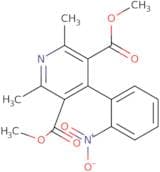
CAS 67035-22-7
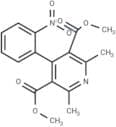
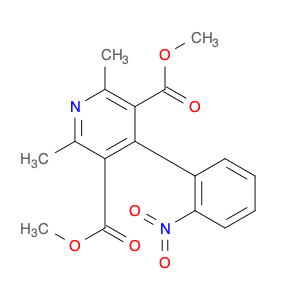
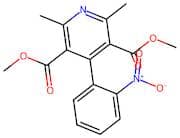
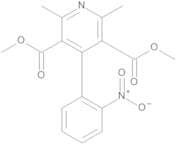
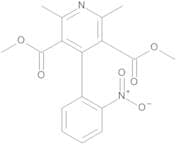
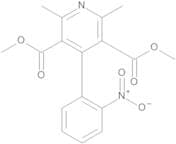
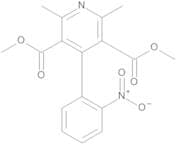
:Dehydronifedipine
Description:
Dehydronifedipine is a chemical compound that belongs to the class of dihydropyridine calcium channel blockers, primarily used in the treatment of hypertension and angina. It is a derivative of nifedipine, characterized by the absence of a hydrogen atom at a specific position in its molecular structure, which influences its pharmacological properties. The compound typically exhibits a lipophilic nature, allowing for good membrane permeability, which is essential for its action on vascular smooth muscle cells. Dehydronifedipine functions by inhibiting calcium influx through voltage-gated calcium channels, leading to vasodilation and a subsequent decrease in blood pressure. Its pharmacokinetics may include a relatively rapid onset of action, with a duration that can vary based on formulation. Additionally, like other dihydropyridines, it may have side effects such as peripheral edema, flushing, and palpitations. As with any medication, its use should be guided by a healthcare professional, considering potential interactions and contraindications.
Formula:C17H16N2O6
InChI:InChI=1S/C17H16N2O6/c1-9-13(16(20)24-3)15(14(10(2)18-9)17(21)25-4)11-7-5-6-8-12(11)19(22)23/h5-8H,1-4H3
InChI key:InChIKey=UMQHJQGNGLQJPF-UHFFFAOYSA-N
SMILES:C(OC)(=O)C=1C(=C(C(OC)=O)C(C)=NC1C)C2=C(N(=O)=O)C=CC=C2
Synonyms:- 3,5-Pyridinedicarboxylic Acid, 2,6-Dimethyl-4-(2-Nitrophenyl)-, Dimethyl Ester
- 3,5-Pyridinedicarboxylic acid, 2,6-dimethyl-4-(2-nitrophenyl)-, 3,5-dimethyl ester
- B 4759
- BAY-b 4759
- Dehydronifedipine
- Dimethyl 2,6-dimethyl-4-(2-nitrophenyl)-3,5-pyridinedicarboxylate
- Dimethyl 2,6-dimethyl-4-(2-nitrophenyl)pyridine-3,5-dicarboxylate
Sort by
Purity (%)
0
100
|
0
|
50
|
90
|
95
|
100
Found 15 products.
Dimethyl-2,6-dimethyl-4-(2-nitrophenyl)pyridine-3,5-dicarboxylate
CAS:Dimethyl-2,6-dimethyl-4-(2-nitrophenyl)pyridine-3,5-dicarboxylateColor and Shape:Light YellowNifedipine Nitrophenylpyridine Analog (Dimethyl 4-(2-nitrophenyl)-2,6-dimethylpyridine-3,5-dicarboxylate)
CAS:Compounds containing an unfused pyridine ring in the structure, nesoiFormula:C17H16N2O6Color and Shape:White Yellow PowderMolecular weight:344.10084Dehydro Nifedipine
CAS:Dehydro Nifedipine (BAY-b 4759), main human plasma nifedipine metabolite, blocks glucose in PC-12 cells, IC50 at 130 μM, forms via CYP3A4/3A5.Formula:C17H16N2O6Purity:99.51%Color and Shape:SolidMolecular weight:344.324-(2-Nitrophenyl)-2,6-dimethylpyridine-3,5-dicarboxylic acid dimethyl ester
CAS:Formula:C17H16N2O6Purity:99%Color and Shape:SolidMolecular weight:344.3187Nifedipine EP Impurity A (Dehydro Nifedipine)
CAS:Formula:C17H16N2O6Color and Shape:Pale Yellow SolidMolecular weight:344.32Dimethyl 2,6-Dimethyl-4-(2-nitrophenyl)pyridine-3,5-dicarboxylate (Nitrophenylpyridine Analogue of Nifedipine)
CAS:Controlled ProductFormula:C17H16N2O6Color and Shape:Light YellowMolecular weight:344.32Dehydronifedipine 100 µg/mL in Acetonitrile
CAS:Formula:C17H16N2O6Color and Shape:Single SolutionMolecular weight:344.32Dehydro Nifedipine
CAS:Controlled ProductImpurity Nifedipine EP Impurity A
Applications The main Nifedipine metabolite in human plasma.This compound is a contaminant of emerging concern (CECs).
References Guengerich, F., et al.: J. Biol. Chem., 261, 5051 (1986), Bork, R., et al.: J. Biol. Chem., 264, 910 (1989), Kerla, V., et al.: Biochem. Pharmacol., 44, 1745 (1992),Formula:C17H16N2O6Color and Shape:Light YellowMolecular weight:344.32Dehydro nifedipine
CAS:Dehydronifedipine is a drug used for the treatment of hypertension. It is a prodrug that is converted in vivo to nifedipine, its active form. Dehydronifedipine has been shown to have inhibitory effects on rat liver microsomes and human serum. It has also been shown to be transported by the drug transporter p-glycoprotein (p-gp). Dehydronifedipine binds covalently to cytochrome P450 enzymes and inhibits their activity. This inhibition may lead to decreased metabolism of other drugs, leading to toxicities or adverse reactions. The levels of dehydronifedipine in plasma can be determined with an LC-MS/MS method. The concentration–time curve for this drug can be used to determine the time needed for half of the drug dose to be eliminated from the body, which is important when considering the appropriate dosing regimen for this medication.Formula:C17H16N2O6Purity:Min. 98 Area-%Color and Shape:White PowderMolecular weight:344.32 g/mol