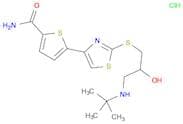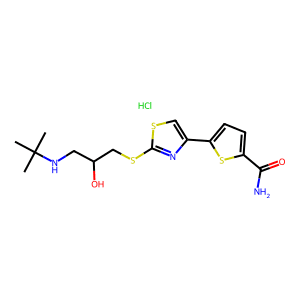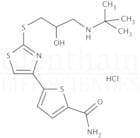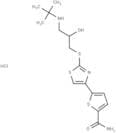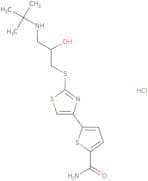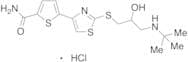
CAS 68377-91-3
:Arotinolol hydrochloride
- 2-Thiophenecarboxamide, 5-[2-[[3-[(1,1-dimethylethyl)amino]-2-hydroxypropyl]thio]-4-thiazolyl]-, hydrochloride (1:1)
- 2-Thiophenecarboxamide, 5-[2-[[3-[(1,1-dimethylethyl)amino]-2-hydroxypropyl]thio]-4-thiazolyl]-, monohydrochloride
- 2-Thiophenecarboxamide, 5-[2-[[3-[(1,1-dimethylethyl)amino]-2-hydroxypropyl]thio]-4-thiazolyl]-, monohydrochloride, (S)-
- 5-(2-{[3-(Tert-Butylamino)-2-Hydroxypropyl]Sulfanyl}-1,3-Thiazol-4-Yl)Thiophene-2-Carboxamide
- Almarl
- Arotinolol Hcl
- S 596
- Arotinolol hydrochloride
Arotinolol HCl
CAS:Formula:C15H21N3O2S3·HClColor and Shape:White To Off-White SolidMolecular weight:371.53 36.46Arotinolol hydrochloride
CAS:Arotinolol HCl is a non-selective α/β-blocker, anti-hypertensive, anti-obesity, and improves aortic stiffness.
Formula:C15H22ClN3O2S3Purity:99.84%Color and Shape:SolidMolecular weight:408Arotinolol hydrochloride
CAS:Arotinolol hydrochloride is a beta-blocker that, in contrast to propranolol, has a higher selectivity for the β1 receptor. It is used to treat hypertension and angina pectoris. Arotinolol hydrochloride lowers blood pressure by inhibiting the activity of α-adrenergic receptors, which are found in the heart and vascular smooth muscle. This inhibition reduces the release of norepinephrine and causes vasodilation. Arotinolol hydrochloride also has a positive effect on cardiac function as it decreases myocardial oxygen demand and increases coronary flow. Arotinolol hydrochloride has been shown to lower systolic pressure in anesthetized dogs with an intravenous dose of sodium citrate. The drug also lowers diastolic pressure in conscious dogs at doses of 0.5 mg/kg (0.2 mg/lb) or greater when given intravenously or subcutaneously.
Formula:C15H22ClN3O2S3Purity:Min. 98%Color and Shape:PowderMolecular weight:408 g/molArotinolol Hydrochloride
CAS:Controlled ProductApplications Arotinolol is both and alpha- and beta-adrenoceptor antagonist and is used to treat essential tremors and hypertension.
References Kuroda, Y., et al.: Neurology, 38, 650 (1988); Miyagishi, A., et al.: Arch. Pharmacodyn. Ther., 271, 249 (1984); Wu, H., et al.: Hypertens. Res.: Off. J. Jpn. Soc. Hypertens., 24, 605 (2001)Formula:C15H21N3O2S3·ClHColor and Shape:NeatMolecular weight:408.002